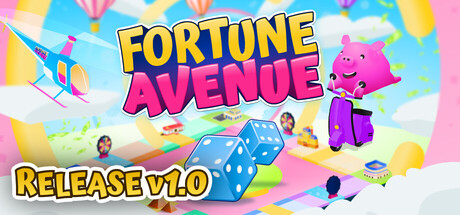
Fortune Avenue scores 72/100 — better than 42% of Early Access capsules (n=3,067).

Quick text summary

Fortune Avenue scored 72/100 on Steam Analyzer — Good for a Early Access capsule. Top priority fix: [genre_clarity] Add a visual motif that hints at voting or strategy—such as a ballot icon, chart, or hand gesture—to differentiate from generic board games and telegraph the core mechanic.

Capsule scores by dimension

  • Genre Clarity: 7/10 — Board game and party vibes clear. The large blue dice in the center, colorful board game aesthetic, and playful character design immediately signal a casual, festive board game experience. At TINY size, the dice and bright pastel palette still read as game-themed, though the specific multiplayer competitive angle is less obvious without text. Genre ambiguity arises between party game, casino, and general casual simulation—the dice suggest chance-based mechanics but don't clearly signal the voting/strategy layer.
  • Title Readability: 8/10 — Title bold and legible at scale. FORTUNE AVENUE is rendered in large, high-contrast yellow and magenta stacked text with a clear black outline, positioned in the upper-center region against a lighter sky background. At SMALL size (231x87), the title remains readable and retains its visual hierarchy; at TINY size (120x45), letterforms compress but the outline and color separation hold. The tagline and smaller text below are not readable at TINY size, but the main title stands strong.
  • Contrast & Color: 8/10 — Vibrant palette pops against dark. The bright magenta, cyan, yellow, and pink color scheme creates strong value separation and saturation against the dark Steam background. The blue dice, purple character, and warm yellow title all feature clear silhouettes and edge definition that survive the squint test and grayscale conversion. Sky background lightness and foreground object saturation work together to create visual punch without muddiness.
  • Uniqueness & Polish: 7/10 — Festive, polished casual aesthetic. The capsule displays clean 3D rendering, intentional color coordination, and a cohesive party-game vibe with confetti, stylized character, and thematic props (dice, hotels, airports hinted in layout). The execution feels premium for its category with good lighting and no cheap asset feel. However, the core visual concept—colorful board game scene with dice and characters—is a familiar template in casual gaming, lacking a distinctive hook that communicates the voting or competitive strategy mechanics.
  • Brand Consistency: 6/10 — Solid visual identity but generic. The pastel color palette, playful character design, and 3D board game aesthetic are consistent and recognizable within this capsule, with no jarring style shifts or conflicting render approaches. However, there are no iconic symbols, memorable motifs, or signature design elements (like a character mark, logo icon, or visual trademark) that would persist across multiple marketing touchpoints or allow instant recognition outside this capsule context. The visual identity is competent but not distinctly branded.
  • Composition: 7/10 — Clear hierarchy, balanced layout. Title occupies the strong upper region with supporting elements (dice, character, props) distributed across the mid-lower area in a roughly balanced composition with good use of depth and layering. At SMALL size, the focal point (blue dice and purple character) reads clearly and guides attention well. At TINY size, the composition holds—dice and character remain distinct, though fine details and secondary props (hotels, airports in background) become visual noise.

What works

  • Title contrast and legibility. Yellow and magenta text with black outlines stands out sharply against the background and remains readable even at compressed small sizes.
  • Color palette saturation and pop. Vibrant pastels and bright accents create strong visual separation from the Steam dark background without feeling harsh or oversaturated.
  • Clean 3D rendering and craft. Lighting, shading, and asset quality across the dice, character, and props feel polished and intentional, not template-based or cheap.
  • Focal point clarity at smaller sizes. The blue dice and purple character remain the primary visual anchor and hold attention at SMALL and TINY sizes without being lost in clutter.

What hurts the capsule

  • Generic board game concept. The visual setup (colorful dice, game pieces, festive scene) is a familiar template in casual gaming and doesn't communicate what makes Fortune Avenue unique—voting mechanics, competitive bankruptcy, or hotel-building strategy are not visually hinted.
  • No iconic brand symbol. The capsule lacks a memorable logo, character mark, or visual trademark that would make the game instantly recognizable on a wishlist or storefront shelf without the title.
  • Secondary elements lose clarity at TINY. Background props, small character details, and scene context compress and blur at 120x45 size, creating visual noise that dilutes the primary message.
  • Tagline and descriptive text illegible. Any text below the main title is too small to read at SMALL and TINY sizes, limiting ability to communicate core gameplay hooks visually.

Priority fixes

  1. [genre_clarity] Add a visual motif that hints at voting or strategy—such as a ballot icon, chart, or hand gesture—to differentiate from generic board games and telegraph the core mechanic.
  2. [uniqueness_polish] Develop an iconic character or mascot mark that can appear consistently across store assets and serve as an instant brand recognition cue.
  3. [composition] Reduce secondary background clutter and strengthen the foreground subject (dice + character) so at TINY size the focal point dominates and distracting details recede.
  4. [title_readability] Consider adding a small tagline visual (icon or badge) next to the title that encodes one core gameplay concept (e.g., 'Vote to Win' or 'Bankrupt Rivals') to communicate unique value without relying on small readable text.

Store copy priority fixes

  1. [hook_strength] Remove or rewrite the opening preamble paragraph starting with 'Imagine a world' to lead directly with the voting mechanic and a concrete consequence ('Every 12 rolls, all players vote on rule changes that can flip the game state—one vote might bring back all 5-star hotels, another might teleport you across the board via airport').
  2. [feature_communication] Add a brief explanation of how the voting mechanic works mechanically (do all players vote, is it majority rule, what happens if votes tie?) so players can visualize the decision point.
  3. [uniqueness] Strengthen the differentiation section by explicitly stating that rule voting mid-game is the core unique mechanic, not just one of many features—clarify why this prevents staleness compared to Monopoly's fixed rules.
  4. [audience_targeting] Add a sentence clarifying whether the game is designed for competitive cutthroat play or casual social fun, or both—currently it signals both but could be more direct (e.g., 'For groups who love negotiation and chaos, not quiet strategy').

Related guides

Steam app ID: 1810050 · Tags: Early Access, Turn-Based, Tabletop, Board Game, Capitalism