Quick text summary
Master of Realms scored 70/100 on Steam Analyzer — Good for a Tabletop capsule. Top priority fix: [genre_clarity] Add a signature mapmaking or design-specific visual icon (compass, grid, terrain symbol) to clearly differentiate this as a creation tool, not a traditional RPG game.
Capsule scores by dimension
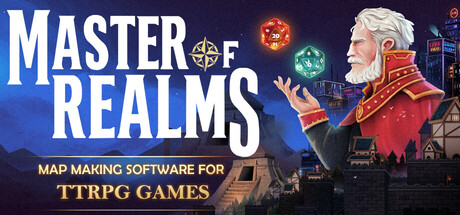
- Genre Clarity: 7/10 — Fantasy RPG utility tool clear. The wizard character in ornate red robes with magical orbs and arcane setting immediately signals fantasy genre. The subtitle 'MAP MAKING SOFTWARE FOR TTRPG GAMES' explicitly clarifies this is a design utility, not a traditional RPG game. At tiny size, the wizard silhouette and magical elements remain recognizable, though the utility purpose is lost without text.
- Title Readability: 8/10 — Bold sans-serif title excellent contrast. The white sans-serif 'MASTER OF REALMS' logotype is large, well-spaced, and positioned on a controlled blue-to-purple gradient background that provides strong value separation. The title remains fully legible at small size and holds its weight at tiny size due to thick letterforms and high contrast against the dark background. The subtitle is smaller and reads clearly at full size but becomes unreadable at tiny sizes, which is acceptable for a secondary descriptor.
- Contrast & Color: 8/10 — Strong vibrant palette high separation. Bright white title, glowing orange and teal magical orbs, and the wizard's vivid red robes all stand out sharply against the deep blue-purple gradient background. The color palette uses saturated hues that create clear silhouette separation even at small sizes. In grayscale, the title and wizard maintain excellent value contrast, with the orbs reading as distinct highlights that guide the eye naturally.
- Uniqueness & Polish: 6/10 — Competent but familiar wizard archetype. The character design features a distinguished wizard with white beard and ornate robes typical of fantasy RPG art, and the magical orbs add visual interest. However, the overall composition leans on well-established fantasy tropes without a distinctive visual hook that communicates the mapmaking/design utility aspect uniquely. The craft is clean and professional, but does not feel exceptionally memorable or premium compared to top-tier RPG utilities.
- Brand Consistency: 6/10 — Generic fantasy branding no signature. The wizard character and magical orb motifs are consistent with classic fantasy RPG presentation, but there are no unique brand identity signals like a signature color palette, iconographic symbol, or distinctive art direction that would make this recognizable as distinctly 'Master of Realms' across future materials. The design follows expected fantasy conventions rather than establishing a memorable internal identity.
- Composition: 7/10 — Clear focal point good layering balance. The wizard character is the primary focal point positioned right of center, with the title anchored top-left and magical orbs providing secondary highlights. Background cityscape, mid-ground character, and foreground title create clear depth separation that reads well at all sizes. The composition avoids clutter and maintains safe margins, though the title's upper-left positioning leaves the right side of the design feeling slightly light; at tiny size, the wizard remains the clear primary subject.
What works
- Legible typography with strong contrast. White sans-serif title stands boldly against the gradient background and remains readable even at tiny sizes due to thick letterforms and high value separation.
- Vibrant color palette creates visual pop. Saturated orange and teal magical orbs plus vivid red robes command attention and separate cleanly from the dark background at quick scroll speeds.
- Clear depth and focal hierarchy. Layered composition with title, wizard character, and environmental background creates natural eye flow without competing elements.
What hurts the capsule
- Generic fantasy wizard archetype. The character and visual style follow predictable fantasy RPG conventions without communicating the unique mapmaking software purpose or differentiating from similar titles.
- Subtitle unreadable at small sizes. The 'MAP MAKING SOFTWARE FOR TTRPG GAMES' text is too small to read at small or tiny capsule sizes, losing the critical utility communication.
- No signature brand identity signals. The design lacks memorable iconography, distinctive palette, or recognizable motifs that would establish lasting brand recognition separate from generic fantasy themes.
Priority fixes
- [genre_clarity] Add a signature mapmaking or design-specific visual icon (compass, grid, terrain symbol) to clearly differentiate this as a creation tool, not a traditional RPG game.
- [title_readability] Increase subtitle size or reposition it to be readable at small capsule size, or use an abbreviated descriptor that maintains the utility message in a scalable format.
- [uniqueness_polish] Develop a distinctive art direction or brand motif—such as a unique rune set, color signature, or stylized map element—that communicates the core mapmaking feature and feels premium compared to generic fantasy utilities.
Store copy priority fixes
- [hook_strength] Rewrite the opening line of the detailed description to lead with a concrete workflow benefit ('Create tabletop maps in minutes, export to 3D print, VTT, or paper') instead of 'revolutionary' marketing language.
- [tone_match] Remove or replace hyperbolic phrases ('jaw-dropping,' 'revolutionary,' 'unleash') with straightforward, benefit-focused language that matches the grounded, practical tone of the short description.
- [uniqueness] Add a sentence explaining the competitive advantage: 'Unlike other map tools, Master of Realms uniquely combines digital VTT-ready maps with 3D-printable terrain in one workflow,' or similar differentiator.
- [feature_communication] Elevate the Early Access disclaimer from the final note to a separate, prominent section near the top, listing known gaps or planned features to set realistic expectations.
Related guides
Steam app ID: 2295940 · Tags: Tabletop, Design & Illustration, Sandbox, 3D, Procedural Generation