Quick text summary
Occlude scored 77/100 on Steam Analyzer — Good for a Strategy capsule. Top priority fix: [genre_clarity] Reinforce the solitaire/puzzle mechanic with subtle UI elements (card stack, dice, puzzle grid outline) to differentiate from generic tarot imagery and clarify the strategic card game subgenre.
Capsule scores by dimension
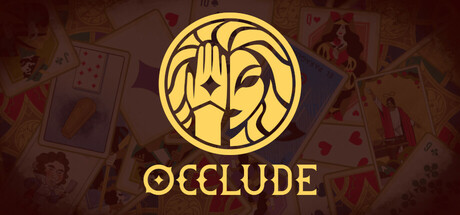
- Genre Clarity: 7/10 — Cosmic horror card game clear. The golden occult symbol and tarot cards in background immediately signal a supernatural card game with mystery/horror elements. At TINY size, the circular emblem and card scatter still communicate mystical strategy, though the specific 'solitaire puzzle' subgenre becomes less obvious without text. The visual language aligns well with cosmic horror and indie strategy expectations.
- Title Readability: 8/10 — Bold gold title reads well. OCCLUDE is rendered in clean, thick golden serif capitals with strong contrast against the dark burgundy background, maintaining legibility at SMALL and TINY sizes. The all-caps treatment and geometric spacing prevent letterform collapse at smaller scales. No tagline clutter distracts from the core word, though full context (that it's a card game) requires the visual context around it.
- Contrast & Color: 8/10 — High-value gold pops effectively. The warm golden #D4AF37 tones create strong luminance separation from the dark maroon/burgundy #3D1A1A background, ensuring the logo and title remain distinct even in quick scrolls and at TINY sizes. The circular emblem has clean edges and reads as a cohesive silhouette against the softer card texture behind it. Grayscale contrast remains solid without relying on saturation alone.
- Uniqueness & Polish: 7/10 — Distinctive occult branding, generic card treatment. The lion-faced circular emblem with geometric line work is a strong, memorable visual hook that signals premium indie polish and thematic coherence with cosmic horror. However, the scattered tarot card background feels like a familiar stock trope in mystical game design—the execution is clean but not distinctly innovative. The overall presentation suggests craft and intentionality, positioning it above generic templates.
- Brand Consistency: 8/10 — Strong occult symbol identity. The golden lion emblem functions as a recognizable brand mark with distinctive line-art style and symmetrical geometry that could carry across multiple marketing materials. The warm gold + dark maroon palette is cohesive and deliberate, reinforcing mystical luxury positioning. The internal consistency between the emblem rendering, typography, and background palette suggests mature art direction aligned with cosmic horror branding.
- Composition: 8/10 — Clear hierarchy, centered focus. The golden circular emblem is centered as the dominant focal point, with OCCLUDE anchored below in perfect visual balance, and scattered cards provide supporting depth without competing for attention. At SMALL and TINY sizes, the composition collapses cleanly to emblem + title with minimal loss of impact. The safe margins protect the core elements from edge cropping, though the card scatter at edges could be vulnerable to aggressive cropping.
What works
- Memorable icon system. The geometric lion emblem is distinctive and scalable, functioning as a strong brand mark that will read at all sizes and could become iconic for repeat recognition.
- Legible title typography. Bold golden capitals with clean spacing maintain full readability from full header down to TINY thumbnail without letterform degradation.
- Strong value contrast. The luminance separation between gold and dark maroon ensures the design pops against Steam's #1b2838 background and survives quick-scroll evaluation.
- Thematic coherence. The occult-mystical visual language (lion emblem, tarot cards, gold tones) aligns cohesively with cosmic horror positioning and game premise.
What hurts the capsule
- Generic card scatter background. The scattered tarot card pattern feels familiar and template-like in indie mystical game design, reducing distinctiveness despite clean execution.
- Card details lost at tiny size. Individual tarot cards in the background become illegible visual noise at TINY size, adding visual texture that doesn't contribute to clarity or brand messaging.
- Limited gameplay communication. While the mystical theme is clear, the 'solitaire puzzle' core mechanic and 'narrative ritual' hook are not visually evident—the design reads more as generic mysticism than specific game type.
Priority fixes
- [genre_clarity] Reinforce the solitaire/puzzle mechanic with subtle UI elements (card stack, dice, puzzle grid outline) to differentiate from generic tarot imagery and clarify the strategic card game subgenre.
- [uniqueness_polish] Replace or stylize the scattered card background with a more bespoke pattern (geometric occult symbols, constellation map, or forbidden lore scrawl) that reinforces the 'ritual disguised as solitaire' concept rather than reusing familiar tarot scatter.
- [composition] Ensure card scatter at bottom edges won't be aggressively cropped on smaller Steam display contexts; tighten the vertical composition or fade cards near edges.
Store copy priority fixes
- [feature_communication] Clarify the core discovery loop: 'You uncover hidden rules through play and experimentation; coins indicate progress toward solutions.' This explains what 'hidden rulesets' actually means in practice.
- [feature_communication] Add a brief explanation of Story Mode vs. Classic Mode in the short description or early in detailed copy: 'Story Mode reduces punishing RNG and offers unlimited Undo for narrative-focused players; Classic Mode demands mastery.'
- [hook_strength] Strengthen the opening line slightly by adding a consequence verb: 'Occlude is a ritual disguised as Solitaire—one wrong move and reality fractures further' to heighten the stakes immediately.
Related guides
Steam app ID: 3547010 · Tags: Strategy, Solitaire, Puzzle, Card Game, Horror