Quick text summary
LEO: Low Earth Orbit scored 73/100 on Steam Analyzer — Good for a Action Roguelike capsule. Top priority fix: [genre_clarity] Incorporate visual cues of the dual-joystick combat loop, such as energy trails, multiple projectile paths, or a horde silhouette, to clarify the experimental arsenal and weaving mechanics at tiny size.
Capsule scores by dimension
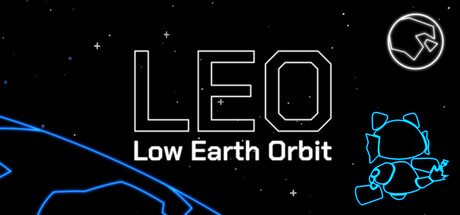
- Genre Clarity: 7/10 — Sci-fi action shooter clear. The neon blue orbital mechanics outlined on the right side, starfield background, and geometric robot silhouette immediately signal a space-themed action game. At tiny size, the LEO acronym and orbital visuals still read as sci-fi, though the specific dual-joystick roguelike loop is not apparent from visuals alone. The blue neon outline style is distinctive enough to suggest indie action rather than AAA.
- Title Readability: 8/10 — Bold outline text crisp. The LEO title in thick outline letterforms maintains excellent clarity at all sizes due to high contrast white strokes on black background with no competing texture behind it. The tagline 'Low Earth Orbit' below is also readable at small size. At tiny size the title remains legible as a recognizable block, supporting quick discoverability.
- Contrast & Color: 8/10 — Strong neon blue pop. The bright cyan/blue neon elements (orbital lines, robot outline, decorative edge stroke on left) create sharp separation against the pure black background and dark starfield. The white title text and cyan accents establish clear value hierarchy that survives squinting and grayscale conversion. At tiny size the blue silhouette and white text maintain distinct visual edges.
- Uniqueness & Polish: 7/10 — Polished neon aesthetic distinct. The capsule demonstrates intentional design with a cohesive neon outline art direction that feels premium and matches modern indie action style benchmarks like Lethal Company or experimental indie shooters. The geometric robot character and orbital flow lines communicate innovation in movement mechanics rather than generic combat. However, the design relies on a familiar synthwave/neon trend that, while well-executed, is not entirely unique in the current indie space.
- Brand Consistency: 7/10 — Neon geometric style iconic. The neon outline aesthetic and geometric robot motif create a recognizable visual identity that likely carries across store screenshots. The cyan color palette, outline stroke style, and sci-fi orbital theme establish internal cohesion. Without seeing all 5 store screenshots, the neon robot and LEO branding appear strong enough to form a memorable brand silhouette that would be identifiable in a storefront scroll.
- Composition: 7/10 — Balanced layout clear focus. The LEO title anchors the center-upper area with strong hierarchy, flanked by the orbital robot on the right and decorative blue line edge on the left, creating balanced negative space. The starfield background provides context without competing with foreground elements. At small size, all major elements (title, robot, accent lines) remain within safe margins and read as a unified composition without clutter or awkward gaps.
What works
- Title remains crisp at tiny size. Outline letterforms with no serifs or thin strokes ensure LEO is instantly recognizable even at 120×45 thumbnail resolution.
- Neon blue pops against dark background. Cyan orbital lines and robot outline create strong silhouette separation that survives squinting and maintains value contrast in grayscale.
- Cohesive sci-fi action identity. Geometric robot character, orbital mechanics visuals, and neon aesthetic work together to suggest innovative movement-based combat gameplay.
- Balanced composition without clutter. Left accent line, centered title, and right-side robot create symmetrical spacing that avoids dead center voids or scattered attention.
What hurts the capsule
- Limited color palette reduces standout. Reliance on white, black, and cyan creates a clean look but follows a familiar neon indie trend that blends with other synthwave-styled games.
- Robot silhouette lacks gameplay specificity. The geometric bot outline is visually appealing but does not clearly communicate the dual-joystick control scheme or horde-weaving core loop that differentiates it.
- Starfield background feels generic. Scattered stars are a standard space game trope that does not reinforce unique selling points about low-earth-orbit combat mechanics.
Priority fixes
- [genre_clarity] Incorporate visual cues of the dual-joystick combat loop, such as energy trails, multiple projectile paths, or a horde silhouette, to clarify the experimental arsenal and weaving mechanics at tiny size.
- [uniqueness_polish] Consider adding a signature visual hook or motion element (e.g., dynamic thrust glow, unique robot animation, or orbital trajectory arc) that distinguishes LEO from standard neon indie shooters.
- [brand_consistency] Test the robot character and neon palette consistency across all 5 store screenshots to ensure the orbital-geometric motif reinforces brand recognition throughout the storefront.
Store copy priority fixes
- [hook_strength] Replace 'Fluid movement, experimental arsenals, and a little robot' with a clause that emphasizes the unique mechanic: e.g., 'where every weapon blast propels you forward, turning combat into a constant dance of momentum and firepower.'
- [feature_communication] Add 1-2 concrete examples of upgrade types or playstyles (e.g., 'heavy slow weapons, rapid-fire builds, or explosive setups') to help players visualize customization depth.
- [audience_targeting] Clarify the difficulty curve and target player skill level explicitly: e.g., 'master the controls and dominate chaos' for veterans, or 'pick up and play in short bursts' for casual players—choose one or reconcile them.
Related guides
Steam app ID: 3583240 · Tags: Action Roguelike, Twin Stick Shooter, Beat 'em up, PvE, Space