Quick text summary
PLAYNESE: Master Japanese scored 67/100 on Steam Analyzer — Solid for a Early Access capsule. Top priority fix: [genre_clarity] Add a subtle visual element that signals language learning or JLPT progression (e.g., floating characters, a book prop, dialogue bubbles) to clarify the educational game loop
Capsule scores by dimension
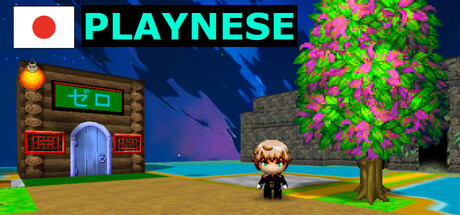
- Genre Clarity: 6/10 — Casual adventure with educational overlay unclear. The capsule shows a whimsical low-poly scene with a character, house, tree, and flowers suggesting a casual adventure or life sim, but the educational Japanese learning component is not visually communicated at all sizes. At tiny size, the Japanese flag and 'PLAYNESE' text hint at language learning, but the gameplay genre remains ambiguous—it could be mistaken for a standard cozy adventure game without the descriptor text.
- Title Readability: 8/10 — Bold cyan title reads well across sizes. The 'PLAYNESE' title in bright cyan is highly legible at full size and remains readable at small size due to strong contrast against the darker blue sky background and clean sans-serif letterforms. At tiny size it compresses but maintains enough clarity to be recognized, though fine details of the Japanese flag icon become less distinct.
- Contrast & Color: 7/10 — Good separation with bright accents. The bright cyan title, neon green foliage, and colorful UI elements (blue door, red signs, orange glow) create strong value separation against the dark blue sky and ground. The composition uses saturated colors effectively, though at tiny size some mid-tone elements (like the brown house) blend slightly into the background, reducing overall silhouette crispness.
- Uniqueness & Polish: 6/10 — Competent low-poly scene lacks distinctive hook. The scene is well-crafted with consistent low-poly aesthetic and thoughtful environmental details like the neon signs and flowering tree, but it communicates a generic cozy world rather than a unique selling point or memorable visual identity. The capsule does not clearly signal what makes this educational game visually or mechanically distinctive compared to other casual adventures, leaning on pleasant execution rather than standout concept.
- Brand Consistency: 6/10 — Japanese theme present but visually generic. The capsule uses Japanese flag and theme-appropriate elements (house style, tree, peaceful setting) to signal cultural identity, but these are common in many games and do not create a memorable or unique brand signature. Without reference to other marketing materials, the visual identity is competent but interchangeable with other cozy games, lacking distinctive iconography or character recognition that would make it memorable on repeat exposure.
- Composition: 7/10 — Clear focal point with balanced layout. The character is positioned as the clear primary subject in the center, with supporting environmental elements (building, tree, foliage) guiding the eye and creating depth layering. At small and tiny sizes, the composition holds well with the character remaining the focal anchor, though the right-side pink flowers compete slightly for attention and the title placement at top-left is safe but conventional.
What works
- Strong title contrast and readability. Bright cyan 'PLAYNESE' text maintains clarity across full, small, and tiny sizes with excellent contrast against the darker background.
- Effective depth and scene layering. Clear foreground character, midground house and tree, and background sky create visual hierarchy that works at reduced sizes.
- Vibrant color palette with saturation control. Neon accents (cyan title, green foliage, red signs) stand out against the cooler blue background without feeling chaotic or oversaturated.
What hurts the capsule
- Educational game genre is not visually communicated. The capsule reads as a generic casual adventure with no visual cues suggesting language learning or JLPT study, making the core value proposition invisible.
- Lacks distinctive visual identity or memorable hook. The low-poly aesthetic and scene composition, while competent, are common in many cozy games and do not establish a unique brand signature.
- Right-side foliage competes with focal point. The bright pink flowers on the right create a secondary attention zone that slightly divides focus away from the center character at small sizes.
Priority fixes
- [genre_clarity] Add a subtle visual element that signals language learning or JLPT progression (e.g., floating characters, a book prop, dialogue bubbles) to clarify the educational game loop
- [uniqueness_polish] Introduce a distinctive character trait, UI signature, or thematic visual that makes the game's learning-focused identity immediately recognizable and memorable
- [composition] Reduce the visual weight of the right-side foliage by lowering saturation or scale to strengthen center-subject dominance across small and tiny viewports
Store copy priority fixes
- [feature_communication] Add 1–2 sentences explaining the card battle system and how it ties to Japanese acquisition (e.g., 'Each card has a Japanese name and ability—earn rare cards by mastering vocabulary').
- [hook_strength] Move the 'EARLY ACCESS: Constant Weekly Updates' statement higher in the detailed description, or add a sentence in the short description confirming the game is actively developed and not abandoned.
- [uniqueness] Add a direct comparative or statement of difference (e.g., 'Unlike other language apps, PLAYNESE is a full JRPG where progression depends on learning, not hours spent').
Related guides
Steam app ID: 3764890 · Tags: Early Access, Language Learning, Adventure, JRPG, Open World