Scoring genre clarity...
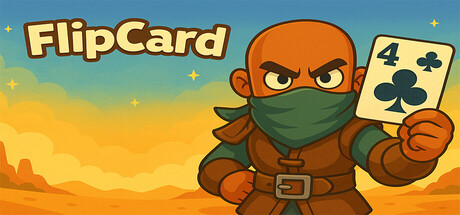
FlipCard capsule

FlipCard

If you know topological sorting, you will quickly understand how to play this game. The cards on the left are the predecessors of the cards on the right. Eliminate the cards without predecessors first, and you will win if you finally clear all the cards.

$0.99
CasualCard GameSolitaire
konggmittJul 7, 2025

FlipCard scores 70/100 — better than 29% of Casual capsules (n=10,153).

$0.99 · Released Jul 7, 2025 · By konggmitt

Quick text summary

FlipCard scored 70/100 on Steam Analyzer — Good for a Casual capsule. Top priority fix: [genre_clarity] Reposition or redesign the background setting to communicate card strategy or puzzle mechanics visually—consider adding stacked cards, game board elements, or visual motifs that hint at topological sorting rather than a generic desert warrior.

Capsule scores by dimension

  • Genre Clarity: 7/10 — Card game mechanic clear, setting ambiguous. The prominent playing card held by the character immediately signals a card game at all sizes. The casual art style and playful character support a puzzle or strategy card game genre. However, the desert soldier setting and character pose do not clearly communicate the specific topological sorting mechanic or casual strategy nature—the visual theme feels disconnected from the core gameplay loop, making genre feel slightly muddled at tiny size.
  • Title Readability: 8/10 — Title readable across all sizes with bold styling. The 'FlipCard' title uses a bold yellow outline font positioned in the upper left against a clear sky background, ensuring strong legibility at full, small, and tiny sizes. The letterforms remain distinct even at thumbnail scale due to generous stroke weight and color contrast. No taglines or extra text compete for attention, keeping the visual hierarchy clean and the title clearly the primary text element.
  • Contrast & Color: 8/10 — Strong warm-cool separation with clear silhouettes. The warm orange and yellow gradient sky contrasts effectively against the cool teal-green character and deep blue-black clothing, creating strong value separation that reads well against Steam's dark background. The bright yellow title pops clearly, and the character silhouette remains distinct even at tiny size due to the value range between subject and background. The orange card element adds visual interest without muddying the contrast.
  • Uniqueness & Polish: 6/10 — Competent art but lacks distinctive mechanical hook. The character design and illustration quality are polished with clean lines, intentional shading, and a cohesive cartoon art style that suggests professional craftsmanship. However, the visual does not clearly communicate the unique topological sorting mechanic—it reads as a generic 'angry character with card' rather than a visually distinctive puzzle strategy game, leaving no memorable hook that differentiates it from other card game capsules at a glance.
  • Brand Consistency: 6/10 — Solid art style but limited identity cues. The cartoon character has a recognizable, consistent rendering style with warm orange skin tones, distinct facial features, and intentional clothing design (green mask, belt, brown armor) that could theoretically be reused. However, there are no iconic motifs, symbols, or signature visual elements that scream 'FlipCard'—the desert setting and masked soldier character do not create a memorable brand identity specific to this game and would not stand out on a shelf of card game titles.
  • Composition: 7/10 — Good focal hierarchy with minor edge safety concerns. The character is positioned as the clear primary focal point in the center-right area, with the card held prominently and the title balanced in the upper left, creating a logical visual hierarchy that reads at small and tiny sizes. The gradient background provides depth and context without clutter. However, the character's right arm and the card element sit close to the right edge, creating minor crop vulnerability on some Steam implementations, and the upper left sky space feels slightly underutilized.

What works

  • Yellow title contrast and clarity. Bold outline 'FlipCard' text remains legible at all sizes including tiny thumbnails due to stroke weight and yellow-on-sky placement avoiding texture noise.
  • Warm-cool color separation. Orange gradient sky and warm character tones contrast sharply against cool greens and dark clothing, creating silhouettes that read clearly against Steam's dark background even at thumbnail scale.
  • Polished character illustration. The masked character is well-rendered with intentional shading, clear linework, and distinct visual personality that conveys professional craftsmanship.
  • Clear primary focal point. The centered character with prominent card creates unambiguous visual hierarchy at small and tiny sizes with minimal distraction from secondary elements.

What hurts the capsule

  • Disconnected visual theme. Desert soldier aesthetic clashes with card game genre and obscures the topological sorting mechanic, creating visual-gameplay mismatch that weakens genre clarity.
  • Generic mechanic communication. Single card element does not visually suggest the game's unique puzzle strategy nature—could apply to hundreds of casual card games without distinctive visual storytelling.
  • Right edge element vulnerability. Character arm and card sit close to right margin creating potential crop risk on certain Steam implementations or scaling scenarios.
  • No recognizable brand identity. Masked soldier and desert setting lack memorable icons, motifs, or signature visual language that would make the brand instantly recognizable in a library of similar games.

Priority fixes

  1. [genre_clarity] Reposition or redesign the background setting to communicate card strategy or puzzle mechanics visually—consider adding stacked cards, game board elements, or visual motifs that hint at topological sorting rather than a generic desert warrior.
  2. [uniqueness_polish] Add a distinctive visual hook specific to the core mechanic—such as connected card chains, flow diagrams, or a visual metaphor for predecessor relationships that makes the game's unique selling point instantly apparent.
  3. [composition] Move the character and card element slightly left to increase right-edge safety margin and ensure no critical elements sit at crop boundaries across Steam implementations.
  4. [brand_consistency] Establish a recognizable brand symbol or color palette motif that could serve as an identity anchor across store screenshots and marketing—currently the character alone cannot carry brand recall.

Store copy priority fixes

  1. [hook_strength] Replace the opening line entirely. Lead with the core fun: 'Flip cards and solve the puzzle – clear the board by finding cards with no blockers. A fresh twist on solitaire that challenges your logic and memory.' This removes jargon, explains what you do, and hints at the unique mechanic without alienating casual players.
  2. [feature_communication] Rewrite the detailed description to unify the two conflicting game modes. Clarify: Is it a logic puzzle where you must eliminate cards in prerequisite order, OR a memory/matching game? State this explicitly in the first sentence.
  3. [audience_targeting] Add 1–2 sentences that explicitly celebrate the game's accessibility and fun: 'Perfect for a quick brain teaser or a relaxing puzzle session – no prior knowledge needed.' This signals to casual players that the game is for them.
  4. [tone_match] Inject personality that matches the Cute and Funny tags. Replace formal language like 'sharpest minds' with warmer, playful phrasing that feels lighthearted and inviting, not intimidating.

Related guides

Steam app ID: 3812170 · Tags: Casual, Card Game, Solitaire, 3D, Cartoon