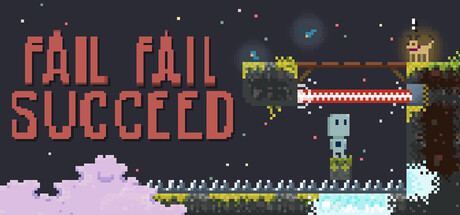
Fail Fail Succeed scores 68/100 — better than 19% of 2D Platformer capsules (n=1,970).

Quick text summary

Fail Fail Succeed scored 68/100 on Steam Analyzer — Solid for a 2D Platformer capsule. Top priority fix: [uniqueness_polish] Introduce or emphasize the dog companion character as a visible visual anchor to create memorable brand identity and communicate the emotional 'quiet comfort' hook.

Capsule scores by dimension

  • Genre Clarity: 7/10 — Pixel art puzzle platformer clear. The retro pixel-art aesthetic and isometric platforming environment with hazards (spikes, moving platforms) immediately signals indie puzzle-platformer. The dream-world discomfort vibe reads through the eerie pastel color palette and fragmented architectural elements, though the core mechanic (learning through failure) is not visually explicit at tiny size. At TINY size the platformer intent is clear, but the 'failure as tool' concept requires reading the title.
  • Title Readability: 8/10 — Bold title strong legibility. The oversized 'FAIL FAIL SUCCEED' title in warm orange-red block letters dominates the left side with excellent contrast against the dark background and reads crisply at all sizes down to TINY. The geometric sans-serif typeface maintains letterform integrity at small scales with no decorative loss. Placement on the dark upper-left region keeps text away from cluttered background detail, preserving readability.
  • Contrast & Color: 7/10 — Strong warm-cool separation. The warm coral-orange title pops decisively against the cool dark navy-blue background, creating clear value separation visible even at TINY size. The isometric environment uses yellow, white, and light cyan accents that create distinct silhouettes; however, the mid-tone pink-purple platforms in the lower area compress contrast slightly and blend toward the dark background in grayscale. Overall the design holds clarity at small scale with only minor mid-tone mudding.
  • Uniqueness & Polish: 6/10 — Competent retro craft, generic theme. The pixel-art execution is clean and well-rendered with consistent dithering and color palette control; however, the dreamlike isometric platformer scene is a familiar indie trope without a distinctive visual hook that separates it from other retro-puzzle games. The dog companion mentioned in the description is not visible or communicated in the capsule, missing an opportunity for memorable brand differentiation. Polish is solid but concept feels like a well-made variant rather than a standout originality.
  • Brand Consistency: 6/10 — Cohesive art, minimal identity signals. The palette, pixel-art rendering style, and isometric perspective are internally consistent across the composition with no jarring style breaks. However, there are no iconic character, symbol, or signature motif visible that would anchor brand recognition on repeat exposure—the style is competent retro without memorable identity cues like a mascot or recurring visual motif. Without reference to the 11 other screenshots, this capsule reads as generic pixel-art platformer rather than distinctly 'Fail Fail Succeed.'
  • Composition: 7/10 — Clear hierarchy, title dominates well. The bold left-aligned title creates strong primary hierarchy and draws immediate attention, with the isometric environment serving as supporting visual context on the right. Depth layering (background sky, midground platforms, foreground hazards) is clear and prevents a flat read. At SMALL and TINY sizes the title remains the focal point and the environmental silhouette reads as cohesive platformer scene; however, the lower-right area contains busy layered platforms that risk becoming visual noise at the smallest scales.

What works

  • Excellent title contrast and size. The warm coral-orange 'FAIL FAIL SUCCEED' text is oversized, bold, and highly legible at all scales including TINY, with perfect dark-background placement.
  • Clear platformer genre communication. The isometric pixel-art environment with visible spikes, moving platforms, and architectural hazards instantly signals puzzle-platformer gameplay to genre-savvy players.
  • Consistent pixel-art execution. The dithering, color palette, and rendering style are uniform throughout with no stylistic breaks or cheap asset feel.

What hurts the capsule

  • Missing core mechanic visual cue. The 'failure as learning tool' central mechanic is not visually communicated—only readable through the title, reducing gameplay clarity at TINY size.
  • No distinctive brand identity visible. The capsule reads as a competent retro platformer with no iconic character, symbol, or signature element that would anchor brand recall (the dog companion is absent).
  • Busy platform detail at small scales. The layered platforms and architectural elements in the lower-right quadrant risk becoming visual noise and lose clarity hierarchy when compressed to TINY size.

Priority fixes

  1. [uniqueness_polish] Introduce or emphasize the dog companion character as a visible visual anchor to create memorable brand identity and communicate the emotional 'quiet comfort' hook.
  2. [genre_clarity] Add a subtle visual cue suggesting the failure-loop mechanic, such as a ghost character, rewind effect, or repeated silhouettes, to clarify the core gameplay at TINY size.
  3. [composition] Reduce layering complexity in the lower-right platform cluster or increase value separation between layers to maintain visual hierarchy at TINY scales.

Store copy priority fixes

  1. [hook_strength] Clarify 'She' in the detailed description opening by replacing 'She wants to guide you forward' with 'A loyal dog wants to guide you forward' to anchor the emotional core immediately.
  2. [feature_communication] Expand the 'Fail To Succeed' section to include a concrete example (e.g., 'Your failed jump leaves a platform others can use') so the mechanic becomes tangible rather than metaphorical.
  3. [uniqueness] Add a 1-2 sentence comparison or positioning statement in the short description (e.g., 'Unlike platformers where failure means restarting, here every mistake is a tool') to make differentiation even more explicit.
  4. [tone_match] Include a brief sensory or visual descriptor of the dream world (e.g., 'desaturated,' 'abstract,' 'haunting') to reinforce the atmospheric tag and emotional tone throughout the copy.

Related guides

Steam app ID: 3816180 · Tags: 2D Platformer, Puzzle Platformer, Puzzle, Platformer, Indie