Quick text summary
Pillar of Salt scored 70/100 on Steam Analyzer — Good for a Strategy capsule. Top priority fix: [genre_clarity] Integrate a visual cue that signals 'tactical' or 'roguelike'—e.g., a grid overlay, time icon, or branching path—to differentiate the core mechanic and justify the unique positioning versus standard RPGs.
Capsule scores by dimension
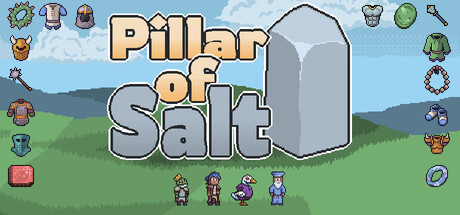
- Genre Clarity: 7/10 — RPG setting clear, tactics unclear. The pixel art style, green pastoral landscape, and character party lineup at the bottom immediately signal a classic RPG. However, the 'real-time tactical roguelike' core mechanic is not visually evident—it reads as a standard turn-based fantasy RPG at all sizes. The central stone pillar and sky suggest an adventure narrative, but tactical depth and roguelike replayability loops are invisible.
- Title Readability: 8/10 — Title legible, clean presentation. The 'Pillar of Salt' logo uses a cream-colored, outline-heavy blocky font centered on a sky backdrop with strong contrast against the Steam dark background. At TINY size the text remains readable due to thick letterforms and high value separation. The tagline 'or' between words is proportionate and does not clutter the layout.
- Contrast & Color: 8/10 — Strong value range, clear separation. The capsule employs a bright blue sky, green grass, and pale stone pillar that create high contrast against #1b2838. The cream title text pops cleanly, and character silhouettes at the bottom remain distinct even when squinted. Grayscale test shows no muddy mid-tones; light and dark elements separate crisply.
- Uniqueness & Polish: 6/10 — Retro charm, generic fantasy scene. The pixel art aesthetic and whimsical stone pillar composition show craft and intentionality, evoking classic 16-bit RPGs. However, the scene itself—pastoral landscape with mountain, pillar, and character lineup—reads as a standard fantasy setup without a distinctive visual hook or unique selling point that differentiates it from dozens of retro RPG capsules. The art is competent but the concept is familiar.
- Brand Consistency: 6/10 — Consistent pixel style, no signature motif. The capsule maintains a uniform retro pixel art rendering style and warm color palette (greens, blues, creams) throughout. However, there is no recognizable character icon, logo symbol, or distinctive visual shorthand that would allow a player to identify 'Pillar of Salt' in a sea of other retro RPG titles. The aesthetic is coherent but not memorable.
- Composition: 7/10 — Clear focal point, balanced layout. The stone pillar anchors the center as the primary subject, flanked symmetrically by sky and landscape. The title sits comfortably above, and the party of characters grounds the lower edge. At SMALL and TINY sizes the composition remains legible with no critical elements lost to cropping. However, the layout is fairly centered and static—there is no dynamic depth layering or asymmetric tension that would elevate the design.
What works
- Readable title at all sizes. Cream outline font on sky background maintains legibility even at TINY thumbnail size due to thick letterforms and high contrast.
- Strong color-to-background separation. Bright blues, greens, and pale tones create excellent value separation against the dark Steam background and remain distinct when grayscale-tested.
- Clean pixel art execution. Consistent retro art style across all elements signals craft and appeals to the target indie RPG audience.
What hurts the capsule
- Mechanic identity is invisible. Real-time tactical roguelike depth is not communicated visually; the capsule reads as a generic turn-based fantasy RPG at all sizes.
- Generic fantasy scene. Pastoral landscape with stone pillar and party is a familiar trope with no distinctive visual hook or unique selling point that stands out among competing retro RPGs.
- No memorable brand signature. No iconic character, logo symbol, or distinctive visual motif that would allow players to recognize the game's identity in future marketing or crowded store pages.
Priority fixes
- [genre_clarity] Integrate a visual cue that signals 'tactical' or 'roguelike'—e.g., a grid overlay, time icon, or branching path—to differentiate the core mechanic and justify the unique positioning versus standard RPGs.
- [uniqueness_polish] Introduce a signature character, enemy, or environmental prop (e.g., a distinctive villain silhouette, deity manifestation, or salt-themed visual motif) that becomes the game's visual identity and differentiates it from generic retro RPG templates.
- [composition] Add asymmetric depth or dynamic foreground-to-background layering to increase visual interest and guide the eye beyond the static center-pillar layout.
Store copy priority fixes
- [uniqueness] Replace 'unique take on RPG combat' with a specific, concrete mechanic that only this game offers—e.g., 'ability queuing lets you plan three turns ahead while battles play in real-time' or compare directly to what other auto-battlers lack.
- [hook_strength] Rewrite the opening to lead with a core verb and consequence: 'Build an unstoppable party, design a broken build, and race up the Mountain of Power before divine judgment falls in three days.'
- [audience_targeting] Add explicit difficulty language: specify whether this is designed for roguelike veterans, tactical puzzle solvers, or newcomers, and clarify what 'challenging yourself with a 1 character run' actually means in difficulty terms.
- [uniqueness] Develop the three-day apocalypse into a unique selling point by explaining how it pressures strategy or shapes progression differently than other roguelikes—does it affect shop timing, boss scaling, or narrative outcomes?
Related guides
Steam app ID: 3900000 · Tags: Strategy, Roguelike, Auto Battler, Party-Based RPG, Fantasy