Scoring genre clarity...

Who is Dumb capsule

Who is Dumb

Who is Dumb? is a fun multiplayer trivia quiz game! Play with 1–8 players, test your knowledge, compete with friends, and climb the leaderboards. Don’t finish last… or you’ll be the dumb one!

$1.99
CasualTriviaPuzzle
Artneron GamesOct 20, 2025

Who is Dumb scores 77/100 — better than 75% of Casual capsules (n=10,153).

$1.99 · Released Oct 20, 2025 · By Artneron Games

Quick text summary

Who is Dumb scored 77/100 on Steam Analyzer — Good for a Casual capsule. Top priority fix: [uniqueness_polish] Integrate a subtle visual element that hints at trivia or knowledge—such as a question mark icon, thought bubble, or quiz board element—to differentiate from generic party games and communicate the core mechanic.

Capsule scores by dimension

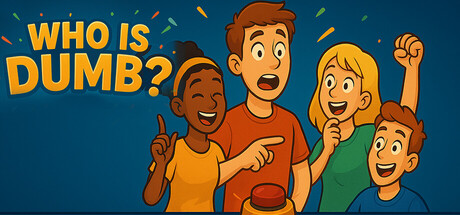
  • Genre Clarity: 8/10 — Clear casual party game vibes. The cartoon art style, bright colors, and group of diverse characters celebrating together immediately signal a fun, social, multiplayer experience. The animated poses and cheerful expressions read as party game or trivia game at any size. At tiny size, the group composition and celebratory body language still convey the multiplayer social game intent clearly.
  • Title Readability: 9/10 — Bold, readable title placement. The large orange 'WHO IS DUMB?' text sits on a clean dark blue background in the top-left, with excellent contrast and bold sans-serif letterforms that remain fully legible at tiny size. The text does not compete with background noise and maintains clarity even at 120x45 pixel thumbnail scale. Strategic placement and weight make it one of the strongest readable elements on the capsule.
  • Contrast & Color: 8/10 — Strong value separation and saturation. The vibrant orange title text pops distinctly against the dark blue background, and the warm skin tones and colorful clothing of the characters create good separation from the cool blue. Saturation is controlled without feeling oversaturated, and the silhouettes of all four characters remain clear even when squinting. The overall warm-versus-cool palette ensures strong visual pop at any viewing size.
  • Uniqueness & Polish: 7/10 — Cheerful cartoon style, solid execution. The clean cartoon character art with consistent line work and appealing character design feels polished and purposeful rather than generic. The celebratory pose composition communicates the fun, social nature of the game well. However, the overall aesthetic is not groundbreaking—cartoon party game characters are familiar territory—so while execution is solid, the visual concept itself lacks a distinctive hook that would make it instantly memorable in the casual game space.
  • Brand Consistency: 6/10 — Competent cartoon style, limited identity. The art direction is consistent within this capsule—all characters use the same cartoon rendering, color palette is unified, and the tone is coherent. Without reference to additional store screenshots, the visual identity reads as generic cheerful cartoon party game art rather than a distinctive brand signature. The capsule does not yet establish a memorable iconic character, symbol, or palette that would be recognizable across marketing materials.
  • Composition: 8/10 — Clear hierarchy, balanced focal point. The four characters are arranged in a diagonal grouping that naturally draws the eye to the center-right, with the title anchored safely in the top-left outside the main focal area. The confetti accents frame the scene without creating clutter, and no important elements sit dangerously close to edges that would be cropped at small sizes. The layout remains readable and balanced at small and tiny scales with no dead space or awkward voids.

What works

  • Excellent title contrast and legibility. Large orange text on dark blue background reads perfectly at all sizes including tiny thumbnail, ensuring the game title is immediately identifiable in store browsing.
  • Strong genre signaling through composition. The grouped, celebratory pose of multiple diverse characters immediately communicates multiplayer social gameplay without requiring text interpretation.
  • Clean, consistent cartoon rendering. Polished character art with cohesive line weight and color application gives the capsule a professional, intentional feel rather than template-based.
  • Balanced layout with safe margins. No important elements crowd edges or overlap the title; focal point is clear with supporting confetti adding visual interest without causing clutter at small sizes.

What hurts the capsule

  • Generic cartoon party game aesthetic. While well-executed, the cheerful cartoon character style is familiar territory in casual games and lacks a distinctive visual hook or unique art direction that stands out from similar titles.
  • Limited brand identity signals. The capsule establishes no iconic character, memorable symbol, or signature visual motif that would be immediately recognizable as 'Who is Dumb?' versus any other party game.
  • No gameplay mechanic visual hint. The capsule communicates 'multiplayer party game' but does not visually hint at the core trivia quiz mechanic through UI elements, question marks, or knowledge-related iconography.

Priority fixes

  1. [uniqueness_polish] Integrate a subtle visual element that hints at trivia or knowledge—such as a question mark icon, thought bubble, or quiz board element—to differentiate from generic party games and communicate the core mechanic.
  2. [brand_consistency] Develop a signature visual motif or iconic character pose/expression that can serve as a recognizable brand identifier across all marketing materials and store screenshots.
  3. [genre_clarity] Consider adding a small UI element or symbol (e.g., scoreboard, leaderboard indicator, or quiz interface hint) to the composition to explicitly signal the trivia game subgenre rather than just general multiplayer party vibe.

Store copy priority fixes

  1. [uniqueness] Add a concrete differentiating feature or mechanic—e.g., 'Lightning-fast rounds with random category twists,' or 'Answer questions while racing in real-time head-to-head duels,' or whatever unique system exists—to explain why this game stands out from other trivia titles.
  2. [feature_communication] Expand on what 'strategy' means in the context of trivia—do players have power-ups, can they sabotage opponents, is there a betting system, or is it pure speed and knowledge? Clarify the moment-to-moment gameplay loop.
  3. [audience_targeting] Add a sentence describing solo player benefits or progression systems (e.g., 'Master 500+ questions in solo mode or prove your skill against 8 players online') to make the value proposition clearer for all player types.

Related guides

Steam app ID: 3921140 · Tags: Casual, Trivia, Puzzle, Word Game, Puzzle Platformer