Quick text summary
Cards Lie scored 77/100 on Steam Analyzer — Good for a Simulation capsule. Top priority fix: [uniqueness_polish] Introduce a distinctive visual signature or iconic character design element (symbol, color motif, or pose) that differentiates from generic demon card game aesthetics.
Capsule scores by dimension
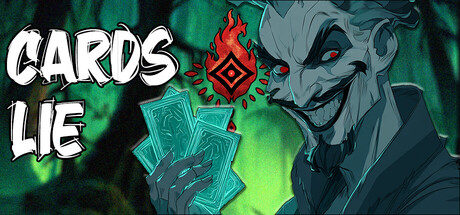
- Genre Clarity: 8/10 — Demon deception card game reads clearly. The demonic character with menacing expression, glowing green aura, and card imagery immediately signal a supernatural deception game with card mechanics. At tiny size, the red demon symbol and playing cards remain distinct enough to convey the core concept of hidden threats and card-based gameplay. The visual hierarchy successfully communicates 'social deduction with cards and demons' without ambiguity.
- Title Readability: 8/10 — Bold white title stands out well. CARDS LIE uses a thick, high-contrast white comic-style font positioned in the upper left against dark background, maintaining legibility at small and tiny sizes. The letterforms remain clear even when squinting, and the placement avoids overlapping with the central character. At tiny size the text still reads as a cohesive two-word title without degradation.
- Contrast & Color: 8/10 — Strong emerald-to-dark gradient separates elements. The bright neon green glow and cyan card accents create excellent value separation against the dark teal background, with the grayscale demon silhouette maintaining sharp edges. The warm red demon symbol provides a secondary accent that pops without overwhelming. At tiny size, the glowing card elements and character outline remain distinctly readable against the background.
- Uniqueness & Polish: 7/10 — Polished demon art with card focus. The character illustration shows solid rendering with intentional lighting and a memorable sneering expression that conveys malice and deception effectively. The integration of glowing cards and the red symbol create a signature visual hook, though the overall composition relies on familiar demon tropes rather than a completely novel hook. The craft quality is above baseline indie work.
- Brand Consistency: 7/10 — Consistent dark supernatural card aesthetic. The color palette of deep teals, neon greens, and red establishes a recognizable identity tied to the demon/deception theme, with the demon character serving as a core visual identifier. The card imagery and glowing effects create internal coherence across the visual language. Without reference to all 9 screenshots, the style feels deliberately crafted but not yet iconic enough for instant recognition separate from the genre.
- Composition: 8/10 — Clear focal hierarchy with balanced layout. The demonic character anchors the right-center composition while the title dominates the left, creating clear separation and logical reading order without clutter. The floating card elements and glowing effects guide the eye without competing for primary attention. At small and tiny sizes, the composition remains stable with no critical elements at dangerous crop edges, and the focal point reads instantly.
What works
- Legible title with strong contrast. White bold font holds clarity across all sizes from full to tiny, with clean outline and zero overlap with game elements.
- Thematic color palette and effects. Neon green glow and cyan cards create a supernatural, high-contrast aesthetic that immediately communicates the game's dark deception theme.
- Clear focal point at all scales. The menacing demon character is the primary subject at every size, supported by secondary card elements that enhance without competing.
What hurts the capsule
- Generic demon archetype execution. While well-rendered, the demon design relies on common horror tropes rather than establishing a unique visual identity that would stand out in the social deduction genre.
- Limited compositional depth layering. The layout is relatively flat with minimal midground separation; background textures feel more like noise than intentional environmental storytelling.
Priority fixes
- [uniqueness_polish] Introduce a distinctive visual signature or iconic character design element (symbol, color motif, or pose) that differentiates from generic demon card game aesthetics.
- [brand_consistency] Establish a more recognizable brand mark or visual pattern that appears consistently across marketing to build instant recall when players scroll past similar-genre titles.
- [composition] Add subtle environmental context or layering in the background that suggests the 'village midnight ritual' setting mentioned in the description, creating richer visual storytelling.
Store copy priority fixes
- [feature_communication] Replace 'Lies that evolve' with a specific explanation: 'Demons change their tactics mid-ritual, forcing you to track their patterns and catch inconsistencies across multiple rounds' to clarify the adaptive challenge.
- [uniqueness] Add 2-3 sentences after the intro paragraph explicitly stating what distinguishes this from other deduction games: e.g., 'Unlike pure social deduction, Cards Lie combines procedural AI deception, hand-drawn narrative cards, and persistent pattern recognition across evolving scenarios.'
- [audience_targeting] Clarify session length and difficulty curve early: 'Perfect for 15-30 minute solo sessions if you're a puzzle solver, or longer playthroughs if you want to master the demons' patterns.'
- [genre_clarity] Remove or recontextualize the RPG tag, or explain progression mechanics if they exist—currently the copy reads as a card deduction game, not an RPG.
Related guides
Steam app ID: 4069260 · Tags: Simulation, Card Game, Casual, Roguelike, Strategy