Quick text summary
The Long Way Home scored 70/100 on Steam Analyzer — Good for a Casual capsule. Top priority fix: [uniqueness_polish] Add a distinctive visual trait to the astronaut (custom suit design, signature equipment, or pose) that signals a unique mechanic or tone beyond generic space exploration.
Capsule scores by dimension
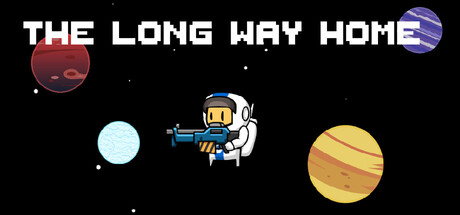
- Genre Clarity: 7/10 — Space exploration indie adventure. The astronaut character with weapon, scattered planets, and cosmic void clearly signal a space-themed indie game. At TINY size, the astronaut silhouette and planet arrangement remain readable enough to suggest sci-fi exploration gameplay. However, the pixel art style and casual tone could suggest multiple indie subgenres, so clarity is good but not absolute.
- Title Readability: 8/10 — Clear, high contrast typography. The title 'THE LONG WAY HOME' uses bold white sans-serif lettering against the black background with strong value separation and clean letterforms. At SMALL and TINY sizes, the text remains fully legible with no collapse in readability. The spacing and weight are well-controlled, making it one of the strongest elements of the capsule.
- Contrast & Color: 8/10 — Strong value separation, clean silhouettes. White title text pops sharply against black, and the colorful planets (red, blue, yellow, purple) create clear visual separation through both hue and brightness. The astronaut figure in blue and white maintains silhouette clarity even at tiny size, and the sparse dot stars provide depth without clutter. Grayscale test shows distinct value separation throughout.
- Uniqueness & Polish: 6/10 — Competent pixel art, narrative-focused premise. The pixel art astronaut and planet assets are cleanly rendered with good detail, and the composition hints at a journey narrative through spatial arrangement. However, the visual approach feels relatively generic within indie game aesthetics—scattered planets in space is a common trope—and the assets do not immediately signal a unique mechanic or distinctive hook. The polish is solid but the concept reads as familiar.
- Brand Consistency: 6/10 — Minimal recurring identity signals. The astronaut character could serve as a recurring identity element, but without reference to the 5 store screenshots, internal cohesion is hard to fully assess. The black background, pixel art style, and color palette (reds, yellows, blues on dark) appear coherent, but there are no immediately iconic symbols, logos, or motifs that create a strong brand signature. The design is consistent but not particularly memorable.
- Composition: 7/10 — Clear focal point, balanced layout. The astronaut is placed as the central focal point with planets distributed around it to guide the eye without overwhelming the composition. At SMALL and TINY sizes, the astronaut remains the clear primary subject, and the planet arrangement creates natural visual flow. Safe margins are respected and the layout feels intentional, though the scattered planets could be seen as slightly loose compared to tighter genre-leading capsules.
What works
- Excellent title legibility. White bold sans-serif type with strong contrast against black background reads perfectly at all sizes, including TINY.
- Clear focal point hierarchy. Astronaut center figure immediately draws attention with planets supporting the composition rather than competing for focus.
- Cohesive dark palette with bright accents. Black void background with colorful planets creates silhouette clarity and visual pop that works across all viewing scales.
What hurts the capsule
- Generic sci-fi concept. Scattered planets and space astronaut motif is familiar within indie games and does not immediately communicate a unique hook or distinctive premise.
- Limited brand identity signals. No iconic character design, signature symbol, or memorable art direction that would allow recognition beyond the title text.
- Narrative ambiguity at small size. The game's core premise 'some may never find their way back' is not visually implied by the composition; title carries all narrative weight.
Priority fixes
- [uniqueness_polish] Add a distinctive visual trait to the astronaut (custom suit design, signature equipment, or pose) that signals a unique mechanic or tone beyond generic space exploration.
- [genre_clarity] Consider a visual element that implies the 'journey' or 'finding home' narrative—such as a trailing path, directional arrow, or home structure—to strengthen genre and emotional clarity at TINY size.
- [brand_consistency] Introduce a recurring color accent or iconic motif (e.g., a ship silhouette, compass rose, or character-specific emblem) that can serve as a recognizable brand signature across marketing materials.
Store copy priority fixes
- [feature_communication] Expand the detailed description to 150+ words and add 2–3 specific gameplay examples: describe what obstacles vary (asteroid dodging, gravity wells, time pressure), whether there are tools or upgrades, and how progression feels across the journey.
- [uniqueness] Add a single sentence after the premise that articulates what makes this game's mechanics or setting distinct—e.g., 'Physics-based gas control offers intuitive but challenging navigation across procedurally hazardous space routes.'
- [audience_targeting] Include a brief note about difficulty/tone to guide player expectations—e.g., 'Perfect for casual players seeking a lighthearted but engaging puzzle-platformer' or 'Speedrunners will find hidden optimizations in every route.'
- [hook_strength] Consider tightening the short description's second sentence to avoid meta-commentary that breaks immersion; lead instead with the core stakes or unique mechanic to maintain emotional investment.
Related guides
Steam app ID: 4241230 · Tags: Casual, Arcade, 2D Platformer, 2D, Cartoon