Scoring genre clarity...
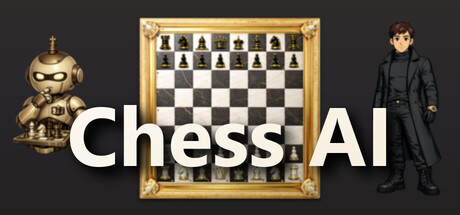
Chess AI capsule

Chess AI

A chess game featuring an adaptive AI opponent that scales to your skill level. Analyze your games move-by-move, track your improvement with detailed statistics, and unlock cosmetics for your avatar, board, and pieces as you progress. Original soundtrack by The Teps. No in-app purchases.

$1.996 user reviews
CasualStrategyBoard Game
General TurtleMar 22, 2026

Chess AI scores 82/100 — better than 92% of Casual capsules (n=10,153).

6 user reviews · $1.99 · Released Mar 22, 2026 · By General Turtle

Quick text summary

Chess AI scored 82/100 on Steam Analyzer — Good for a Casual capsule. Top priority fix: [uniqueness_polish] Introduce a subtle visual element that hints at the adaptive AI or progression system—e.g., a glow effect on the AI robot, a cosmetic customization detail on the human character, or a stat-board accent—to communicate a unique selling point beyond standard chess.

Capsule scores by dimension

  • Genre Clarity: 9/10 — Clear strategy game identity. The centered chessboard with pieces in starting position is an unmistakable visual anchor that immediately communicates strategy gameplay. Even at tiny size, the iconic chess setup remains legible and genre-defining, supported by the flanking character and AI robot that reinforce the human-vs-AI competitive angle. No ambiguity—this is unquestionably a chess game.
  • Title Readability: 9/10 — Bold, readable title treatment. The large white 'Chess AI' text is positioned prominently across the center-lower third with strong contrast against the dark background and chessboard. At small and tiny sizes, the thick sans-serif letterforms remain crisp and legible without serif complexity or decorative flourishes. The title sits in a controlled compositional zone that avoids competing elements.
  • Contrast & Color: 9/10 — Excellent value separation. The white title has strong separation from the dark #1b2838 background; the golden chessboard with ornate frame pops with warm mid-tone contrast; the monochrome chess pieces read clearly against the board. In grayscale, all three core elements (title, board, pieces) maintain distinct silhouettes with no muddy blending, and the character figures provide secondary value peaks.
  • Uniqueness & Polish: 7/10 — Polished but conventional approach. The capsule demonstrates solid craft—clean composition, professional rendering of the chessboard and character figures, and a cohesive dark-to-gold palette. However, the layout follows a predictable three-element horizontal symmetry (robot–board–character) that is functional but lacks a distinctive hook or unique visual storytelling that would elevate it above genre benchmarks. The gold-framed board is elegant but not surprising for chess media.
  • Brand Consistency: 7/10 — Coherent internal style, limited signature. The capsule maintains consistent rendering quality across the robot, board, character, and typography—all rendered in a digital illustration style with clean edges and controlled lighting. The warm gold and dark palette is harmonious, but without access to the six store screenshots, internal brand signals are limited to this single capsule; the style suggests a premium indie game but does not yet establish a uniquely recognizable identity motif or icon.
  • Composition: 8/10 — Well-balanced, clear focal point. The composition uses a three-point balance with the chessboard as the dominant central focal point, flanked by the robot and human character as supporting visual anchors that frame the title. The large white title sits in the safe lower-center zone and does not risk cropping at small sizes. At tiny size, the layered depth (background figures, center board, bold text) creates a readable hierarchy, though the horizontal symmetry is slightly rigid.

What works

  • Instant genre recognition. The chessboard setup and pieces communicate strategy gaming immediately at all viewing sizes, leaving no doubt about game type.
  • Title legibility across scales. Large, high-contrast white text remains crisp and readable even at tiny thumbnail size without font complexity.
  • Strong overall contrast. All major elements—title, board, pieces, characters—maintain clear value separation against the dark background with no muddy mid-tones.
  • Professional polish and craft. Clean rendering, intentional color palette, and balanced spacing convey a premium indie game presentation.

What hurts the capsule

  • Symmetrical composition feels static. The robot–board–character three-point balance, while balanced, creates a formal, somewhat generic layout that lacks dynamic visual storytelling.
  • Limited unique visual hook. The capsule reads as competent chess media but does not communicate a distinctive mechanic (adaptive AI, progression, cosmetics) through visual cues alone.
  • No brand identity signature. Without an iconic character, motif, or distinctive palette cue, the capsule would be difficult to recognize as Chess AI specifically versus a generic chess app.

Priority fixes

  1. [uniqueness_polish] Introduce a subtle visual element that hints at the adaptive AI or progression system—e.g., a glow effect on the AI robot, a cosmetic customization detail on the human character, or a stat-board accent—to communicate a unique selling point beyond standard chess.
  2. [brand_consistency] Develop a signature visual motif or icon (e.g., a stylized AI indicator, a cosmetic avatar accent, or a numbered progress cue) that could become a recognizable brand mark across store screenshots and future marketing.
  3. [composition] Consider offsetting the symmetry slightly—e.g., tilting the board angle, layering depth with a blurred background element, or repositioning the title to one side—to create more visual dynamic tension and reduce the formal, rigid feel.

Store copy priority fixes

  1. [hook_strength] Rewrite the short description opening to lead with a benefit or emotional hook: 'Challenge a chess AI that grows smarter as you do — or analyze every move to master the game step by step.' This shifts from passive feature description to active, benefit-driven language.
  2. [uniqueness] Add 1–2 sentences to the detailed description explaining what makes this game's adaptive AI or analysis system distinct (e.g., 'Our AI learns your weak spots and adjusts strategy in real time' or 'See exactly why each move was rated brilliant or poor with transparent evaluation metrics').
  3. [feature_communication] Expand the analysis section with a concrete example or explanation: e.g., 'Review every move with detailed annotations showing why it succeeded or failed, and compare your choices to the best possible move to accelerate your learning.'
  4. [audience_targeting] Add a sentence addressing solo players and relaxation seekers explicitly (e.g., 'Play at your own pace with no time pressure—perfect for a relaxing afternoon of strategic thinking') to strengthen alignment with the 'Relaxing' tag.

Related guides

Steam app ID: 4487170 · Tags: Casual, Strategy, Board Game, Turn-Based Strategy, 2D