Quick text summary
The door has doubts scored 75/100 on Steam Analyzer — Good for a Interactive Fiction capsule. Top priority fix: [uniqueness_polish] Add subtle stylistic flourish to the room or background (patterned floor, warmer lighting, or distinctive architectural detail) to elevate visual polish beyond the single character concept.
Capsule scores by dimension
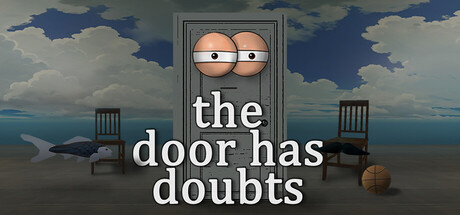
- Genre Clarity: 7/10 — Absurd narrative puzzle clear. The anthropomorphic door with exaggerated eyes immediately signals a quirky, unconventional game—clearly not action or combat-focused. The surreal setup of a furnished room with a distressed door character communicates a narrative-driven, dialogue-based puzzle experience. At TINY size, the expressive door face remains the focal point and distinctly reads as indie adventure rather than mainstream genre, though the exact gameplay loop is not visually obvious.
- Title Readability: 8/10 — Clear sans-serif white text. The title 'the door has doubts' uses clean white sans-serif typography centered over a mid-tone background region, providing strong contrast against both the sky and door. At SMALL and TINY sizes, the text remains legible with good letter spacing and no decorative flourishes that would collapse. The lowercase stylization adds personality without sacrificing readability at any viewing size.
- Contrast & Color: 8/10 — Strong light-dark separation. White title text and the door's bright white eyes pop distinctly against the darker mid-ground and sky gradient. The door character has clear edge definition from its beige/tan body against the gray frame, and the water/landscape background provides layered depth. In grayscale, the value separation remains strong, and at TINY size the door silhouette and text both maintain clear separation from the background.
- Uniqueness & Polish: 7/10 — Distinctive absurdist visual hook. The concept of an anthropomorphic door with anxious expression is visually memorable and immediately distinguishes this from generic adventure fare. The surreal juxtaposition of furniture and existential crisis is communicated through the door's expressive character design and the stark room setting. However, the overall visual execution, while clean, relies on this single clever premise rather than demonstrating exceptional artistic polish or visual storytelling depth.
- Brand Consistency: 7/10 — Cohesive absurdist identity. The capsule establishes a recognizable internal identity: the expressive door character, the minimalist room setting, and the philosophical tone create a unified aesthetic that would be consistent across game materials. The style suggests personality and indie sensibility without signature visual elements like distinctive color palette or recurring motifs that would aid long-term brand recognition. The concept itself is memorable enough to anchor identity, though visual consistency cues beyond this capsule are not evident from the image alone.
- Composition: 8/10 — Clear focal point, balanced layout. The door character occupies the center-upper portion with strong visual weight, while the room setting grounds the composition below. Title text is centered and readable, positioned in the middle third without obscuring the door or competing for attention. The composition maintains hierarchy at SMALL and TINY sizes—the door face is instantly recognizable and remains the primary subject, with supporting elements (furniture, sky, water) framing without cluttering.
What works
- Expressive character focal point. The door's large, exaggerated eyes and anxious expression immediately communicate personality and capture attention at all viewing sizes, creating a memorable and distinctive visual anchor.
- Legible white title contrast. Clean sans-serif white text with strong value contrast against the mid-tone background reads clearly even at TINY size without loss of letterform integrity or readability.
- Effective surreal-absurdist concept. The visual premise of an existential door is sufficiently unique and clever to stand out from typical indie adventure capsules and clearly communicate the game's unconventional narrative focus.
- Layered background composition. The furnished room, landscape, and sky create depth and visual interest while maintaining clear foreground-midground-background separation that supports the door as primary subject.
What hurts the capsule
- Generic room setting lacks polish. While functional, the basic furniture and landscape background feel utilitarian rather than intentionally stylized, reducing the overall premium feel of the capsule.
- Limited visual storytelling beyond premise. The capsule relies heavily on the clever door concept but does not visually communicate core gameplay, theme depth, or unique selling points beyond 'existential door dialogue game.'
- Subdued color palette limits pop. The muted blues, grays, and beiges, while thematically appropriate for melancholy, lack the saturation or warmth that would elevate the capsule to premium-feeling or highly memorable status.
Priority fixes
- [uniqueness_polish] Add subtle stylistic flourish to the room or background (patterned floor, warmer lighting, or distinctive architectural detail) to elevate visual polish beyond the single character concept.
- [contrast_color] Introduce one accent color (warm orange, deep teal, or complementary warm tone) in a supporting element to increase visual interest and pop against the dark Steam background without competing with the door.
- [genre_clarity] Consider adding a subtle dialogue indicator, speech bubble, or UI hint element to more explicitly communicate the dialogue-puzzle nature of the game at TINY size.
Store copy priority fixes
- [feature_communication] Add concrete game length estimate to the short description: 'A very short (30-45 minute) and absurd narrative game...' to clarify scope and replayability expectations.
- [feature_communication] Clarify the exploration vs. dialogue balance: specify whether the room exploration is free-form navigation or constrained dialogue-tree branching to set accurate gameplay expectations.
- [genre_clarity] Replace or supplement the comedic furniture descriptions with one sentence explaining each character's mechanical role (e.g., 'The chair: a red herring NPC with alternative dialogue paths').
Related guides
Steam app ID: 4613620 · Tags: Interactive Fiction, First-Person, Choices Matter, Multiple Endings, Choose Your Own Adventure