Quick text summary
Math Warudo: Grassland & Beyond scored 63/100 on Steam Analyzer — Solid for a Casual capsule. Top priority fix: [genre_clarity] Add a visual gameplay cue—such as a math equation, dungeon environment, or strategy-game UI element—to clearly signal this is a math-adventure hybrid, not a visual novel.
Capsule scores by dimension
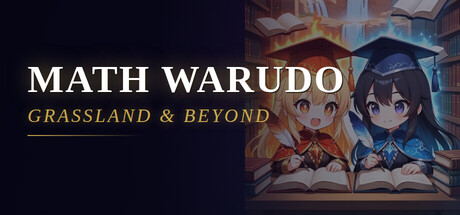
- Genre Clarity: 5/10 — Mixed signals, anime school setting dominates. The capsule prominently features two anime characters in what appears to be a school or library setting with books, which initially reads as a visual novel or slice-of-life game rather than an action-adventure math game. At tiny size, the character focus and cozy aesthetic obscure the actual gameplay genre, making it ambiguous whether this is a puzzle game, adventure, or something else entirely. The math theme is completely invisible in the visual presentation.
- Title Readability: 8/10 — Clean serif font, good contrast and hierarchy. The main title 'MATH WARUDO' uses a readable serif typeface in white with strong contrast against the dark background, and remains legible at small and tiny sizes. The tagline 'GRASSLAND & BEYOND' in gold serif sits below with clear hierarchy, though at tiny size it becomes harder to parse. The title placement in the left two-thirds avoids the character subjects and maintains clarity even under blur and scroll.
- Contrast & Color: 7/10 — Good value separation with warm character lighting. The white title text and gold tagline have strong contrast against the dark navy background, and the warm-lit anime characters on the right side separate well from the darker mid-tones of the library setting. At small size the title remains clearly visible, though the character silhouettes blend slightly with the sepia-toned background elements. The overall grayscale separation is solid but not exceptional, as the background library details compete for attention.
- Uniqueness & Polish: 5/10 — Competent but generic anime school aesthetic. The capsule uses polished character artwork and a clean layout, but the visual identity—two anime characters in a library—is a common trope across casual and indie games with no distinctive visual hook that signals 'math adventure' or unique gameplay. The cozy aesthetic and character art are well-executed, but the composition feels like a standard visual novel or casual game cover rather than something that stands out for its niche math + adventure hybrid. There is no iconic symbol, mechanic hint, or memorable identity cue that suggests this is a math training experience.
- Brand Consistency: 6/10 — Character art consistent, identity signals unclear. The two named characters Toppy and Ame are rendered in a coherent anime style with consistent lighting and detail, suggesting internal art direction consistency. However, there are no visible brand identity cues—no logo, no signature color palette, no iconic symbol or motif that would make this recognizable as 'Math Warudo' across different marketing materials. The warm sepia library background and cool blue character lighting create mild internal tension rather than a unified memorable brand voice.
- Composition: 7/10 — Clear hierarchy, good focal point at small sizes. The title and tagline occupy the left 60% of the frame with ample dark background, while the character subjects anchor the right side, creating a balanced two-zone layout that maintains readability at small and tiny sizes. The focal point (title + characters) is clear and well-separated from the busy library background. At tiny size, the composition still reads as intentional, though edge margins are tight on the right side and some background detail may be cropped on Steam's card display.
What works
- Strong title contrast and serif typography. White 'MATH WARUDO' text and gold tagline have excellent contrast against dark background and remain readable even at tiny capsule size.
- Balanced two-zone composition. Title on left, characters on right creates clear hierarchy and focal point without cluttering or scattering attention across the frame.
- Polished character artwork. The anime character rendering is clean, well-lit, and internally consistent with good detail and visual appeal.
What hurts the capsule
- Genre confusion from visual presentation. The school/library setting and character focus suggest a visual novel or slice-of-life game, completely obscuring that this is a math adventure with action and strategy elements.
- No visual math or gameplay identity. The capsule shows characters and a cozy setting but zero cues about the actual core mechanic—math puzzles, dungeon crawling, or strategy—leaving the game's unique selling point invisible.
- Weak brand recognition signals. No logo, signature motif, iconic symbol, or distinct color palette that would make 'Math Warudo' instantly recognizable or memorable compared to competitor casual games.
- Busy background competes with title at small sizes. While title placement is strong, the sepia-toned library details and character features create visual noise that slightly undermines silhouette clarity under squint and blur tests.
Priority fixes
- [genre_clarity] Add a visual gameplay cue—such as a math equation, dungeon environment, or strategy-game UI element—to clearly signal this is a math-adventure hybrid, not a visual novel.
- [uniqueness_polish] Introduce a distinctive 'Warudo' visual motif, color accent, or iconographic symbol (e.g., stylized world gate, math rune, or branded emblem) in the composition to create instant brand recognition.
- [brand_consistency] Develop a signature secondary color or visual flourish that ties the title, characters, and game concept together into a coherent identity statement, distinct from generic school-setting aesthetics.
Store copy priority fixes
- [feature_communication] Add a specific sentence explaining how math is integrated into gameplay: e.g., 'Solve math challenges to unlock moves, defeat enemies, or unlock secrets within each world' or similar concrete mechanic.
- [hook_strength] Rewrite the opening to lead with what makes this game emotionally engaging: replace 'casual yet rewarding math and dungeon-crawl like experience' with a phrase that highlights the unique blend (e.g., 'journey with Toppy and Ame through five magical worlds where math is the key to survival').
- [uniqueness] Add a sentence explaining what differentiates this from other educational or dungeon-crawling games, such as a specific story hook, unique progression system, or the role Toppy and Ame play in making the narrative memorable.
- [audience_targeting] Specify the intended primary audience in the short description or opening: e.g., 'perfect for families learning math together' or 'for players who love strategy puzzles with a story' to clarify who will enjoy this most.
Related guides
Steam app ID: 4656240 · Tags: Casual, Adventure, Singleplayer, PvE, Action-Adventure