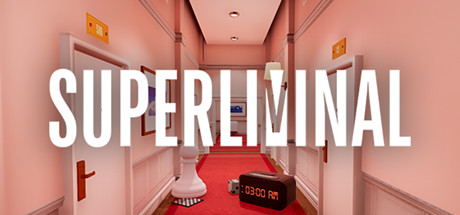
Superliminal scores 73/100 — better than 57% of Puzzle capsules (n=4,501).

Quick text summary

Superliminal scored 73/100 on Steam Analyzer — Good for a Puzzle capsule. Top priority fix: [contrast_color] Add a subtle dark vignette or gradient overlay behind the title text to ensure the white wordmark separates cleanly from the lighter pink wall at all sizes.

Capsule scores by dimension

  • Genre Clarity: 7/10 — Surreal puzzle game implied well. The oversized chess pawn and giant alarm clock placed incongruously in a mundane hotel corridor strongly hint at perspective-manipulation and surreal puzzle mechanics, which is accurate to the game's core concept. At small size the scale-distorted objects still read as 'wrong' and odd, which signals the puzzle genre effectively. At tiny size the genre cue weakens but the strange scale contrast still communicates something unusual and non-action.
  • Title Readability: 8/10 — Bold white title reads clearly. The all-caps bold white sans-serif 'SUPERLIMINAL' is placed center-screen against the relatively neutral pink corridor background, giving good contrast at full size. At small size the letterforms remain legible due to the heavy weight and wide tracking. At tiny size the title compresses but the bold weight holds together reasonably well, though fine details like the 'M' notch in the logo are lost entirely.
  • Contrast & Color: 6/10 — Warm palette competes with Steam dark bg. The warm pink and red corridor palette creates moderate separation against Steam's dark #1b2838 background at the image edges, but the overall image is mid-toned and soft rather than high-contrast. In a grayscale test the white title pops cleanly but the chess pawn and alarm clock both sit in a similar mid-range value to the background carpet and walls, reducing their silhouette clarity at tiny size. No strong dark-to-light edge lighting separates key subjects from the environment.
  • Uniqueness & Polish: 8/10 — Distinctive surreal staging stands out. The deliberate placement of oversized mundane objects — a chess pawn and an alarm clock — in a dreamlike pastel hotel corridor is a memorable and specific visual hook that communicates the game's unique perspective-bending mechanic without text. The 3D render style is clean and polished with consistent lighting and a cohesive aesthetic. Compared to genre benchmarks that lean on character action shots, this environmental storytelling approach feels genuinely distinctive and less derivative.
  • Brand Consistency: 8/10 — Cohesive surreal domestic aesthetic. The warm pastel palette, clean low-poly-adjacent 3D style, and theme of ordinary objects at impossible scales are internally consistent and match the game's known visual identity. The centered bold white wordmark treatment is simple and repeatable as a brand signal. The surreal-domestic visual motif — familiar spaces made strange — is a recognizable identity cue that would translate across marketing materials and screenshots.
  • Composition: 7/10 — Strong central depth, weak focal anchoring. The vanishing-point perspective corridor creates strong depth and draws the eye inward, which is compositionally clever and genre-relevant. The title sits center-frame with clear breathing room. However, the primary hero objects — the chess pawn left of center and the alarm clock right of center — split attention and neither fully anchors as the single focal subject at small size. At tiny size the corridor perspective flattens and the oversized objects become harder to distinguish as intentionally scaled, slightly weakening the impact.

What works

  • Distinctive surreal object staging. Oversized chess pawn and alarm clock in a mundane corridor immediately signal the perspective-manipulation mechanic in a visually unique way.
  • Bold readable title at small size. The heavy all-caps white wordmark maintains legibility down to small capsule sizes due to strong weight and contrast against the corridor.
  • Strong vanishing-point depth. The corridor perspective creates compelling visual depth that reinforces the game's core concept of spatial perception.
  • Cohesive warm pastel art direction. The unified pink-and-red palette and clean 3D rendering style feel intentional and polished rather than assembled from disparate parts.

What hurts the capsule

  • Split focal point weakens tiny-size read. Two hero objects on opposite sides of the frame divide attention at small and tiny sizes, preventing a single strong visual anchor.
  • Low value contrast against Steam background. The warm mid-tone palette does not create a strong silhouette edge against #1b2838, reducing pop in a quick dark-background scroll.
  • Title lacks drop shadow or background separation. Where the white wordmark overlaps lighter pink wall sections, contrast drops and letterforms can merge with the background at small sizes.
  • Genre ambiguity at tiny size. Without the scale-distorted objects reading clearly at tiny thumbnail size, the image could be mistaken for an adventure walking sim rather than a puzzle game.

Priority fixes

  1. [contrast_color] Add a subtle dark vignette or gradient overlay behind the title text to ensure the white wordmark separates cleanly from the lighter pink wall at all sizes.
  2. [composition] Establish one dominant hero object as the clear primary focal point — consider enlarging the chess pawn further or centering it — to prevent split attention at tiny size.
  3. [contrast_color] Increase overall image contrast and add a subtle dark edge vignette so the capsule silhouettes more strongly against Steam's dark #1b2838 background during quick scroll.
  4. [genre_clarity] Consider adding a subtle environmental detail or lighting cue that reinforces the perspective-puzzle mechanic more explicitly at tiny size, such as a shadow that does not match its object.

Store copy priority fixes

  1. [feature_communication] Restructure the detailed description to open with a concrete gameplay action: 'Grab objects and manipulate them in 3D space using forced perspective—what appears small from one angle becomes massive from another. Solve puzzles by exploiting this optical ambiguity.' This immediately clarifies what players do.
  2. [audience_targeting] Add an explicit audience signal: specify playtime ('3–5 hours'), difficulty tone ('cerebral, medium-hard'), and appeal ('for fans of Portal and The Witness who enjoy environmental storytelling').
  3. [tone_match] Consolidate feature sections (commentary, challenge mode, workshop) under the surreal narrative voice rather than generic corporate tone—e.g., 'Dr. Pierce left dev notes throughout the dreamscape' instead of 'extensive developer commentary.'
  4. [hook_strength] Strengthen the short description's action verb from 'escape' to a more visceral or active framing: 'Manipulate perspective and exploit optical illusions to escape a surreal dream world' makes the core verb explicit.

Related guides

Steam app ID: 1049410 · Tags: Puzzle, First-Person, Surreal, Psychological, Physics