Scoring genre clarity...

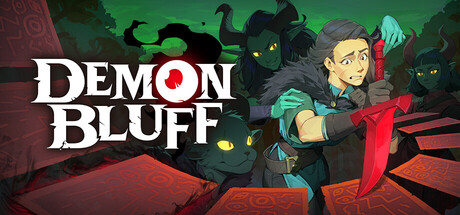
Demon Bluff capsule

Demon Bluff

The cards lie! In this single-player social deduction game, demons have infiltrated your village and disguised themselves as allies. Every card you turn over is either a friend or a foe. Can you see through their bluff?

StrategySocial DeductionRoguelike
UmiArt2026

Demon Bluff scores 70/100 — better than 30% of Steam capsules we've analysed (n=22,658).

Released 2026 · By UmiArt

Quick text summary

Demon Bluff scored 70/100 on Steam Analyzer — Good for a Steam capsule. Top priority fix: [genre_clarity] Add a visible card spread or clearer card game UI element (e.g., facing cards in hand or tableau) to immediately signal social deduction mechanics at all sizes.

Capsule scores by dimension

  • Genre Clarity: 7/10 — Social deduction game clear. The anime-styled character holding a red card, surrounded by shadowy demon silhouettes with glowing eyes, communicates a card game with deception mechanics. At small and tiny sizes, the card prop and demon shapes remain readable enough to suggest bluffing/social deduction gameplay, though the specific genre isn't immediately obvious without context.
  • Title Readability: 8/10 — Bold white title excellent contrast. The 'DEMON BLUFF' title uses thick, bold white letterforms with red accent on the O, positioned in the upper left against a dark gradient background. At full, small, and tiny sizes, the title remains highly legible due to strong value contrast and generous letterform weight; no taglines or secondary text compete for attention.
  • Contrast & Color: 8/10 — Strong value separation clean reads. The capsule uses a dark red-to-green gradient background with bright white title and a tan/yellow character in the mid-foreground, creating clear silhouette separation. The demon shadows with glowing yellow eyes pop effectively against the dark mid-tones, and the red card adds saturated accent; in grayscale, the light character and white title separate cleanly from the darker background.
  • Uniqueness & Polish: 6/10 — Competent anime aesthetic generic feel. The capsule features clean anime-style character art and demon designs with polished rendering, but the composition follows a fairly standard 'protagonist plus threat' template common in indie game marketing. While the art quality is solid, the visual hook doesn't clearly communicate what makes Demon Bluff distinct from other social deduction or card games beyond surface aesthetics.
  • Brand Consistency: 6/10 — Anime style consistent but generic. The art direction is internally coherent with a consistent anime visual language, warm color palette, and character design that likely appears across store assets. However, without strong iconic symbols, signature motifs, or a distinctive art style that couldn't belong to other titles, the brand identity feels safe but not memorable or uniquely recognizable as 'Demon Bluff.'
  • Composition: 7/10 — Clear focal point good balance. The character-with-card in the right-center foreground serves as the clear focal point, with demon silhouettes layered in the background for depth context. At small and tiny sizes, the composition holds well with no critical edge-hugging; the title sits safely left, and empty space around the character avoids clutter, though the right margin crops close to the character's pose.

What works

  • White title legibility. Bold white letterforms with red accent maintain excellent readability across all sizes, never collapsing or blending into the background.
  • Silhouette clarity. Character and demon shapes read as distinct silhouettes in grayscale and at tiny size, quickly communicating the presence of a protagonist versus threats.
  • Color hierarchy. Warm foreground character and cool dark background with green-red gradient create natural depth and guide the eye without competing colors.

What hurts the capsule

  • Genre ambiguity. The card-game and deception mechanic are implied but not immediately obvious; viewers may misinterpret this as an action RPG or supernatural adventure at first glance.
  • Generic visual hook. The anime protagonist-versus-demons composition is a common template that doesn't signal what makes this title's specific social deduction mechanic visually unique.
  • Weak brand identity. No iconic symbol, signature motif, or distinctive visual language that would make this capsule recognizable as 'Demon Bluff' without the title present.

Priority fixes

  1. [genre_clarity] Add a visible card spread or clearer card game UI element (e.g., facing cards in hand or tableau) to immediately signal social deduction mechanics at all sizes.
  2. [uniqueness_polish] Introduce a signature visual hook such as an iconic demon character design, distinctive card art style, or unique color motif that differentiates the capsule from generic anime game templates.
  3. [brand_consistency] Establish a recognizable symbol or mascot (demon character, card icon, or bluff-specific visual) that could anchor the brand identity across all marketing materials.

Store copy priority fixes

  1. [hook_strength] Strengthen the short description by adding one specific consequence or emotional payoff: 'Can you see through their bluff—or will innocent villagers die?' to raise stakes.
  2. [uniqueness] Add a sentence explaining why single-player social deduction works in roguelike form: 'Unlike traditional social deduction games, Demon Bluff lets you solve the mystery at your own pace, with randomized reveals that guarantee a different investigation each run.'
  3. [audience_targeting] Insert an explicit audience signal after the second paragraph: 'Perfect for fans of Inscryption-style deduction puzzles and roguelike progression who want deep replayability without multiplayer wait times.'
  4. [feature_communication] Expand the 'Increasingly complex mechanics' bullet with a concrete example: 'Increasingly complex mechanics like card combos, false clue chains, and demon variants that adapt to your strategy.'

Related guides

Steam app ID: 3522600