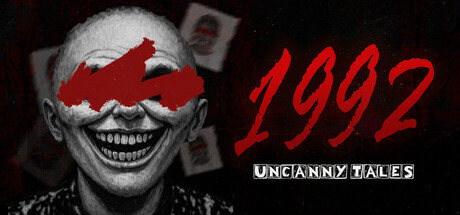
Uncanny Tales: 1992 scores 72/100 — better than 51% of Horror capsules (n=3,118).

Quick text summary

Uncanny Tales: 1992 scored 72/100 on Steam Analyzer — Good for a Horror capsule. Top priority fix: [title_readability] Increase 'UNCANNY TALES' font weight or add a subtle dark outline to improve legibility at TINY size without losing elegance.

Capsule scores by dimension

  • Genre Clarity: 8/10 — Horror mystery with strong genre signals. The grotesque grinning face with red eye mask immediately communicates psychological horror or thriller, reinforced by the monochromatic desaturated tone and unsettling expression. At TINY size, the red mask and white skull-like grin remain readable and genre-specific, though the full mystery-adventure context is not immediately apparent. The visual clearly signals unease and dread rather than casual adventure.
  • Title Readability: 7/10 — Year readable, tagline struggles small. The bold red '1992' reads clearly at all sizes due to high contrast and large letterforms positioned prominently in the right-center. The white 'UNCANNY TALES' text is readable at full and small sizes, but at TINY size the thin letterforms and tight spacing make it slightly fragile. The year stands out as the primary readable element across all viewing conditions.
  • Contrast & Color: 8/10 — Strong red and white separation. The crimson red mask and bold '1992' text create excellent value separation against the dark grayscale background and Steam's #1b2838 color. The white facial features and text provide clean silhouettes that persist even at tiny size. The red maintains saturation without feeling oversaturated, creating a memorable pop that guides attention effectively.
  • Uniqueness & Polish: 7/10 — Distinctive horror hook, minimal execution. The creepy grandfather/archival figure with red-masked eyes is a compelling and unusual visual choice that stands apart from generic horror tropes, suggesting a retro-psychological angle tied to 1992. The design feels intentional and thematic rather than template-based. However, the simplicity of the composition and lack of layered details prevent it from reaching premium polish—it reads more as a strong concept than a fully realized art direction.
  • Brand Consistency: 6/10 — Cohesive aesthetic, limited identity anchor. The monochromatic palette with red accent is internally consistent and reinforces the uncanny, retro-horror tone across all elements. The grinning archival figure creates a memorable visual that could be recognizable, but without additional capsules or brand imagery context, the identity signals are somewhat generic to the psychological horror space. The 1992 date is a strong thematic anchor that ties the visual to the narrative.
  • Composition: 7/10 — Clear focal point, balanced but static. The grotesque face occupies the left-center with the '1992' and title anchored to the right, creating clear hierarchy and visual balance without clutter. The composition reads well at SMALL and TINY sizes, with the face and red mask as primary focal points. However, the static symmetrical layout feels somewhat passive—there is no depth layering or dynamic movement to elevate the composition beyond functional hierarchy.

What works

  • Strong color pop and readability. The crimson red mask and '1992' text contrast sharply against the dark background and remain visually distinct even at tiny size, aiding quick discoverability.
  • Distinctive unsettling visual. The creepy archival figure with red-masked eyes communicates psychological horror and mystery effectively, differentiating from generic adventure capsules in the genre.
  • Clean title hierarchy. The year and tagline are well-positioned with clear spatial separation, maintaining readability across full, small, and tiny viewing conditions.

What hurts the capsule

  • Tagline legibility at tiny size. The white 'UNCANNY TALES' text becomes fragile at thumbnail size due to thin letterforms and close spacing, risking blur during quick scroll.
  • Static composition lacks depth. The layout is symmetrical and frontal without foreground-midground-background layering, resulting in a flat visual presentation that feels more like a poster than an immersive scene.
  • Limited visual storytelling. Beyond the unsettling face, there are no environmental or narrative cues (grandparent setting, missing children, small town atmosphere) visible in the composition to hint at the game's actual mystery-adventure mechanics.

Priority fixes

  1. [title_readability] Increase 'UNCANNY TALES' font weight or add a subtle dark outline to improve legibility at TINY size without losing elegance.
  2. [composition] Add subtle environmental detail (shadowy figures, autumn background, or apartment silhouette) in the background to create depth layering and hint at the narrative context.
  3. [uniqueness_polish] Introduce a secondary visual element or texture (film grain, VHS static, or period-specific detail) to elevate craft and suggest the 1992 retro-horror tone beyond the year text alone.

Store copy priority fixes

  1. [feature_communication] Add 1-2 concrete examples under 'Interactive Environment' showing what examining items reveals (e.g., 'Find a diary with entries hinting at town secrets, examine photos for clues about missing children') to move from abstract to tangible.
  2. [uniqueness] Add a sentence clarifying what makes the 1992 Soviet setting mechanically or narratively relevant beyond visual authenticity—does the era constrain communication/investigation options, influence NPC behavior, or create period-specific dread?
  3. [feature_communication] Specify the scope and pacing: approximate runtime, number of chapters/episodes, and whether choices affect story branches—players need to understand the game's scope.
  4. [audience_targeting] Add a line indicating whether this is designed for horror veterans seeking subtle dread versus newcomers, and whether jump scares or graphic gore are present to set expectations.

Related guides

Steam app ID: 3686940 · Tags: Horror, Thriller, Walking Simulator, Exploration, 3D