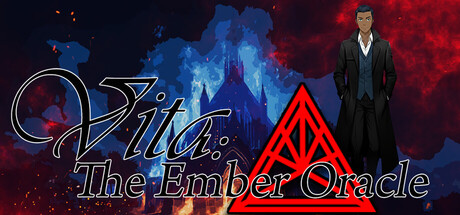
Vita: The Ember Oracle scores 63/100 — better than 9% of JRPG capsules (n=411).

Quick text summary

Vita: The Ember Oracle scored 63/100 on Steam Analyzer — Solid for a JRPG capsule. Top priority fix: [title_readability] Replace ornate script font with a bold, geometric sans-serif that remains legible at TINY size while maintaining fantasy flavor through stylized letterforms or integrated symbolic elements.

Capsule scores by dimension

  • Genre Clarity: 7/10 — RPG fantasy setting reads clearly. The character silhouette in formal attire, mystical blue castle backdrop, and red triangular symbol all signal fantasy RPG immediately. At TINY size, the architectural elements and character pose still communicate a narrative-driven fantasy experience, though the specific 'Vita' mechanic is not visually obvious without context.
  • Title Readability: 6/10 — Title readable at full, degrades at tiny. The serif/script 'Vita:' logo is decorative and maintains legibility at full header size with white outline. At TINY thumbnail (120x45), the ornate letterforms collapse into visual noise and individual letters blur together, making it difficult to parse without squinting. The subtitle 'The Ember Oracle' suffers the same degradation at small sizes.
  • Contrast & Color: 7/10 — Strong contrast with good silhouettes. The red triangle warning symbol pops distinctly against the dark background, and the character in black coat maintains clear separation against the blue-orange gradient castle. The grayscale silhouette test shows strong value contrast between the character and the fiery backdrop, though the blue-to-red color transition creates some mid-tone muddiness in the central area that slightly softens focus.
  • Uniqueness & Polish: 5/10 — Competent but familiar fantasy template. The composition—lone character, mystical architecture, dramatic color gradient, warning symbol—follows a well-worn AAA RPG template seen in competing titles. While technically executed, there is no distinctive visual hook or unique selling point that differentiates this from other mid-tier fantasy RPGs; the Vita concept and fire mechanics are not visually communicated as a fresh mechanic.
  • Brand Consistency: 6/10 — Consistent palette, minimal identity cues. The warm orange-to-cool blue gradient and red triangle symbol are used consistently, but these elements lack iconic specificity—no distinctive character design, logo motif, or signature visual language that would be immediately recognizable in future promotional materials. The character is generic formal-wear rather than a memorable Vita design.
  • Composition: 7/10 — Clear hierarchy, minor edge tension. The character is the primary focal point on the right, the castle and fire occupy the center-left, and the red triangle anchors the lower right. The composition works well at FULL and SMALL sizes with clear depth layering (background fire, midground castle, foreground character), but the title placement along the left edge risks partial cropping on some Steam store views, and the character positioning slightly favors the right edge.

What works

  • Strong color contrast and silhouette. The character and red triangle read distinctly against the dark background, and the overall value separation supports visibility even at TINY thumbnail size.
  • Clear focal point and depth. The layered background (fire), midground (castle), and foreground (character) create visual hierarchy that guides the eye naturally across the composition.
  • Appropriate genre signaling. The combination of formal character, mystical architecture, and dramatic color palette immediately communicates fantasy RPG without ambiguity.

What hurts the capsule

  • Title degrades significantly at small sizes. The ornate serif-script 'Vita:' and smaller 'The Ember Oracle' subtitle become illegible blur at TINY size, reducing discoverability in Steam browse and search results.
  • Generic visual execution without standout hook. The composition and character design follow familiar AAA fantasy RPG tropes without communicating a unique selling point or memorable brand identity distinct from competitors like Dragon's Dogma or Baldur's Gate 3.
  • Red triangle symbol lacks narrative clarity. While visually striking, the red warning triangle is not clearly connected to the Vita/Ember Oracle lore and reads as an abstract design element rather than a thematic or mechanical identifier.
  • Character design is generic and unmemorable. The formal coat-and-tie silhouette provides no distinctive character traits, elemental cues, or visual connection to the 'fire Vita' concept that should be the core identity.

Priority fixes

  1. [title_readability] Replace ornate script font with a bold, geometric sans-serif that remains legible at TINY size while maintaining fantasy flavor through stylized letterforms or integrated symbolic elements.
  2. [uniqueness_polish] Redesign the character to visually embody the 'fire Vita' concept with distinctive clothing, elemental aura, or pose that communicates the core game mechanic and differentiates from generic fantasy RPG protagonists.
  3. [composition] Reposition title to center-left with a dark background bar or gradient underlay to protect against Steam cropping and ensure consistency across all store view sizes.
  4. [brand_consistency] Develop a cohesive visual identity by connecting the red triangle symbol to the Ember Oracle lore—either as a magical sigil, prophecy marker, or UI element that appears in marketing consistently.

Store copy priority fixes

  1. [feature_communication] Add a clarifying sentence to the DRTBS feature explaining how dual resources function—e.g., 'manage two resource types to unlock powerful abilities and adapt mid-battle' rather than leaving mechanics abstract.
  2. [uniqueness] Expand the Late Middle Ages cultural inspiration with one specific concrete example in the Explore Pando section—e.g., name a district inspired by Renaissance Florence or Gothic architecture—to differentiate Pando from generic fantasy cities.
  3. [audience_targeting] Add an explicit statement early in the detailed description that this is chapter three but newcomers can jump in and enjoy the story standalone, removing friction for players unfamiliar with the Vita saga.
  4. [feature_communication] Provide brief tactical context on party switching impact—e.g., 'Swap characters to exploit enemy weaknesses or recover stamina' to show why it matters strategically rather than treating it as an abstract mechanic.

Related guides

Steam app ID: 3862710 · Tags: JRPG, Pixel Graphics, Story Rich, Turn-Based Combat, Stylized