Quick text summary
VI: REM scored 77/100 on Steam Analyzer — Good for a Survival Horror capsule. Top priority fix: [genre_clarity] Add a subtle background element or lighting cue that hints at exploration or multi-dimensional setting (e.g., fractured overlay, dimensional rifts, or flashlight beam) to communicate the core gameplay loop without cluttering the eye focal point.
Capsule scores by dimension
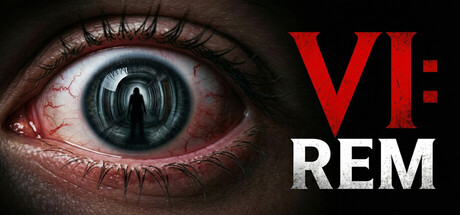
- Genre Clarity: 8/10 — Clear psychological horror intent. The extreme close-up of an infected, dilated eye with visible blood vessels immediately signals psychological horror and body horror. At TINY size, the red eye silhouette and distorted iris remain unmistakably horror-themed, though the specific 'stalker' or exploration mechanics are not visually implied. The eye motif strongly communicates unease and perception-based threat, which aligns well with the game's psychological focus.
- Title Readability: 7/10 — Readable but tight spacing. The title 'VI: REM' uses bold red caps for 'VI:' and white caps for 'REM' on a black background, ensuring strong contrast and legibility at full size. At SMALL and TINY sizes, the letterforms remain distinct and the two-color separation aids quick parsing. The compact four-character layout resists collapse, though some letter-pair tracking could improve spacing at smallest scales.
- Contrast & Color: 8/10 — High-impact red eye dominates. The bloodshot eye with bright red veins and white sclera contrasts sharply against the pure black background and dark skin tones. The red 'VI:' text reinforces the color scheme and pops cleanly. In grayscale squint test, the eye's bright iris and white areas separate clearly from the dark surround, creating strong silhouette even at TINY size against Steam's #1b2838 dark background.
- Uniqueness & Polish: 8/10 — Striking, memorable visual hook. The extreme close-up eye detail with visible capillaries and iris rendering feels intentional and premium rather than generic. This is not a standard character pose or landscape—it's a bold, focused statement on perception and violation of privacy that matches the stalker/exploration premise. The craft quality is evident in the photorealistic eye rendering and deliberate color choice, distinguishing it from typical action-horror templates.
- Brand Consistency: 7/10 — Strong visual motif, limited testing. The eye is a potent recurring symbol for a game about exploration, perception, and psychological threat—it establishes an iconic visual identity tied to the core mechanic of 'seeing' and being watched. Without access to the 8 store screenshots, internal consistency cannot be fully verified, but the eye motif is distinctive enough to become a recognizable brand marker if used coherently across marketing materials.
- Composition: 8/10 — Clear hierarchy, well-balanced layout. The extreme close-up eye occupies the left two-thirds of the frame as a dominant focal point, while the title anchors the right third in a clean, non-overlapping zone. The composition uses depth naturally (eye fills foreground, title in clear background space). At SMALL and TINY sizes, the eye remains the primary subject and the title stays readable without clutter or edge-cutting concerns.
What works
- Iconic visual motif. The bloodshot eye is a memorable, thematically appropriate symbol for a psychological horror game about perception and surveillance.
- Strong contrast and silhouette. Red eye and white text separate clearly against black, maintaining legibility and impact across all viewing sizes including TINY.
- Premium craft quality. The photorealistic eye rendering with capillary detail and focused iris conveys intentional production value, not a template or asset-flip aesthetic.
What hurts the capsule
- Genre mechanics not implied. While the horror is clear, the exploration, flashlight mechanics, multi-dimensional setting, and no-save-point survival pressure are not visually communicated.
- Minimal visual storytelling. The capsule is a single isolated element (eye) rather than a scene or context that hints at the game's unique premise or core hook.
- Title placement relies on symmetry. The right-side title placement is functional but slightly static; title integration could feel more dynamic or compositionally sophisticated.
Priority fixes
- [genre_clarity] Add a subtle background element or lighting cue that hints at exploration or multi-dimensional setting (e.g., fractured overlay, dimensional rifts, or flashlight beam) to communicate the core gameplay loop without cluttering the eye focal point.
- [uniqueness_polish] Consider a thematic context element in the mid-ground (e.g., a doorway, dimensional boundary, or note fragment) that reinforces the 'puzzle-solver in a stalker scenario' pitch while maintaining the eye as primary subject.
- [composition] Test the crop resilience near the eye edges to ensure no critical iris or white area is cut off by Steam's safe margin zones on cards and wishlists.
Store copy priority fixes
- [hook_strength] Replace 'VI: REM is a psychological horror game' with a verb-forward hook like 'Survive a nightmare you cannot escape—find the 6th door's code before your flashlight dies.' This frontloads the core tension and eliminates the generic opener.
- [feature_communication] Add a sentence after 'Someone is Following You' that describes the threat mechanic explicitly: e.g., 'The stalker grows closer when your light wavers; silence and stillness are your only defense.' This clarifies how the player engages with the primary danger.
- [uniqueness] Insert a sentence in the final paragraph that explicitly contrasts this game's approach: e.g., 'Unlike other horror games, your personal memory across playthroughs is the only persistent resource—every run teaches you for the next.' This crystallizes the core differentiator.
Related guides
Steam app ID: 4548330 · Tags: Survival Horror, Action, Psychological Horror, Thriller, Dark